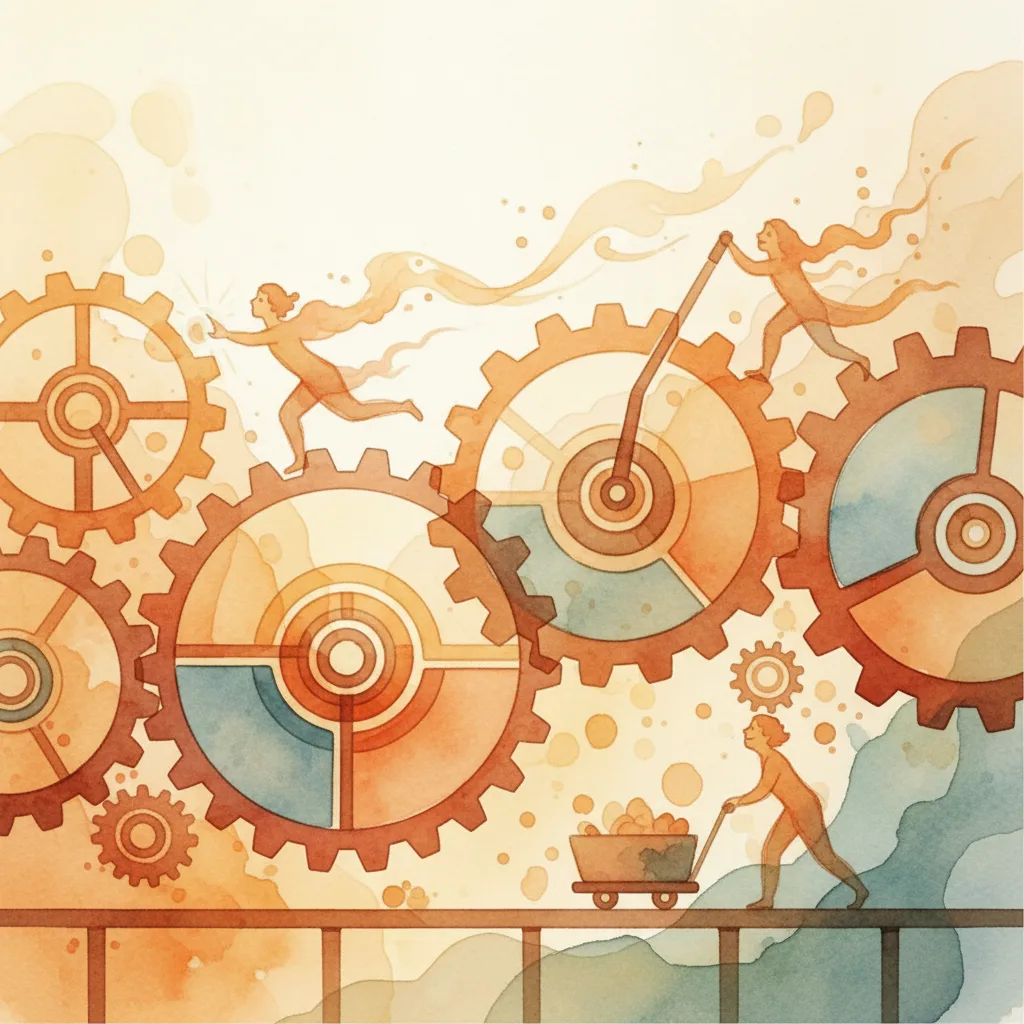

The Default State: Engineering Effortless Action
A behavioral scientist's guide to building sustainable habits by understanding the science of cues, rewards, and environmental design.
The common narrative around habits often champions grit and superhuman willpower. But decades of behavioral science research tell a different story. True habit formation isn't about trying harder; it's about designing smarter. We're looking at the architecture of automaticity – how our brains create shortcuts that allow complex actions to occur with minimal conscious effort.
Every habit, good or bad, follows a predictable three-part loop: Cue, Routine, Reward. The 'cue' is the trigger – that internal feeling or external signal that tells your brain to initiate a behavior. The 'routine' is the behavior itself. And the 'reward' is the positive outcome that reinforces the loop, making you more likely to repeat it next time. Understanding this cycle is the first step to influencing it.
Think of your environment as a powerful, often overlooked, predictor of your actions. B.J. Fogg's work on Tiny Habits emphasizes the profound impact of making desired actions incredibly easy to start. Want to read more? Put a book on your pillow. Want to eat healthier? Keep fruits visible on the counter and junk food out of sight. We are surprisingly susceptible to what is immediately accessible and visible.
Conversely, introducing friction can be a potent deterrent for unwanted behaviors. Deleting social media apps from your phone's home screen, for instance, adds a small but significant barrier, disrupting the automatic 'open-and-scroll' routine. This relates to the concept of 'precommitment' – making a decision in advance that limits your future choices, thereby protecting you from your future, less disciplined self.
Research by Hengchen Dai, Katherine Milkman, and Jason Riis highlights the 'Fresh Start Effect.' We're more likely to pursue goals and make positive changes after temporal landmarks – a new week, month, year, or even after a holiday. These moments create a psychological 'break' with past imperfections, fostering a sense of a new beginning and renewed motivation. Leverage these junctures for new habit initiation.
Beyond what you do, consider who you are. James Clear's work on identity-based habits suggests a deeper level of motivation. Instead of saying 'I want to run a marathon,' frame it as 'I am a runner.' When your actions align with your perceived identity, internal resistance drops, and consistency increases. Your habits become proof of the person you aspire to be.
Our capacity for making good decisions and exerting self-control is finite. Each choice, each act of willpower, draws from a shared mental resource, leading to 'decision fatigue.' This is why we often default to easy, less healthy choices at the end of a long day. Automating decisions through habits conserves this valuable mental energy, freeing up cognitive resources for higher-stakes tasks.
Rewards don't just feel good; they're essential feedback loops that tell our brains, 'Do that again!' Immediate and consistent rewards are most effective in the early stages of habit formation. This isn't necessarily about external treats; it could be the feeling of accomplishment, the boost in energy, or even tracking your progress visibly. Ensure your desired behavior has an immediate, positive payoff.
Breaking bad habits often feels harder than building new ones, and there's a good reason. Existing neural pathways are well-worn grooves. Simply trying to 'stop' rarely works. Instead, focus on replacing the undesirable routine with a more positive one that fulfills the same underlying need or reward. Identify the cue, find the alternative routine, and ensure a satisfactory reward.
Don't underestimate the power of starting small. As B.J. Fogg advocates, make the desired action so minuscule that it feels almost ridiculous not to do it. One push-up. One minute of meditation. Floss one tooth. This strategy builds momentum and confidence, making it easier to scale up over time. The goal is to build consistency, not intensity, initially.
Humans are social creatures, and our habits are deeply influenced by those around us. Surrounding yourself with people who embody the habits you wish to cultivate can be a powerful accelerator. Join a running group if you want to run. Share your goals with a friend for accountability. Our desire for social approval and belonging can be a potent motivator for behavioral change.
What gets measured, gets managed. Tracking your habits – even with a simple 'X' on a calendar – provides crucial feedback and a visual record of your progress. This acts as a reward in itself, satisfying our brain's desire for certainty and accomplishment. Don't break the chain. Seeing a continuous streak can be a powerful motivator to keep going.
No one is perfect. Setbacks are inevitable. The key is not to view them as failures but as data points. What triggered the lapse? How can you prevent it next time? Develop 'if-then' plans (implementation intentions) for potential obstacles. For example, 'If I miss my morning workout, then I will do a 15-minute walk at lunch.'
Habit formation is rarely linear. There's often a 'plateau of latent potential' where effort doesn't immediately translate into visible results, leading to discouragement. Stick with it. Compounding effects are real. Just as a plant grows roots unseen before it sprouts, consistent small actions accumulate into significant transformations over time.
Ultimately, effective habit formation isn't about isolated acts of willpower, but about building robust systems. It's the interplay of environmental design, clear cues, rewarding outcomes, and an identity aligned with your goals. Think like an engineer of your own behavior, continually optimizing your personal operating system.
Start small, be patient, and remember that every choice is an opportunity to cast a vote for the person you want to become. The science is clear: you don't need more willpower; you need a better system. Go build it.