
Spirit's First Flame: Building Community in the Early Church
Explore Acts 2:42-47 to understand the early church's vibrant life. Discover timeless principles for fostering authentic community and spiritual growth in your faith walk today.
Grace and peace to you, friends. Today, we're going to dive deep into a foundational passage that describes the earliest days of the Christian movement—the church immediately following Pentecost. It's easy to look back at the early church through rose-tinted glasses, imagining a perfect community without struggles. While they certainly faced their share of challenges—which we'll touch on later—the picture painted in Acts 2:42-47 offers us a powerful vision of what it means to be the church, in any era.
Luke, the author of Acts, gives us a concise yet profound summary of their collective life. He highlights four key commitments that formed the bedrock of their fledgling community. As we unpack each one, I want us to consider not just what they did, but why they did it, and perhaps more importantly, how these ancient practices can reshape our understanding and experience of faith today.
The first commitment Luke identifies is their devotion to the apostles' teaching. Think about this: these were people who had just witnessed the outpouring of the Holy Spirit, many of them hearing the gospel for the first time on Pentecost. Suddenly, they had a new understanding of God, of Jesus as the Messiah, and of their place in His story.
But the spiritual high of an initial experience isn't enough to sustain faith. True discipleship requires learning, understanding, and internalizing truth. The apostles, as direct witnesses and recipients of Christ's teachings, held the authoritative word. Their teaching wasn't just interesting information; it was the very revelation of God, guiding their beliefs and their daily lives. They didn't just casually attend; they devoted themselves. This implies intentionality, consistency, and a hungry heart for God's word.
So, what does it mean for us to be "devoted to the apostles' teaching" today? It means we must be committed to the consistent study of Scripture, which holds the apostles' authoritative message for us. It means seeking out solid, Christ-centered teaching that faithfully interprets God's word. It means wrestling with biblical truths, allowing them to challenge our assumptions, correct our perspectives, and inform our actions.
It's not about passive listening, but active engagement. Are we prioritizing regular time in God's word? Are we approaching sermons and Bible studies with a hunger to learn and apply, or simply to be entertained? The early church understood that a healthy, growing faith is always deeply rooted in the truth of God's revealed word.
Next, Luke tells us they were devoted to fellowship and to the breaking of bread. These two often go hand-in-hand. Fellowship (koinonia in Greek) is so much more than casual socializing. It speaks of deep partnership, shared life, and mutual participation. It's about genuine connection, vulnerability, and bearing one another's burdens.
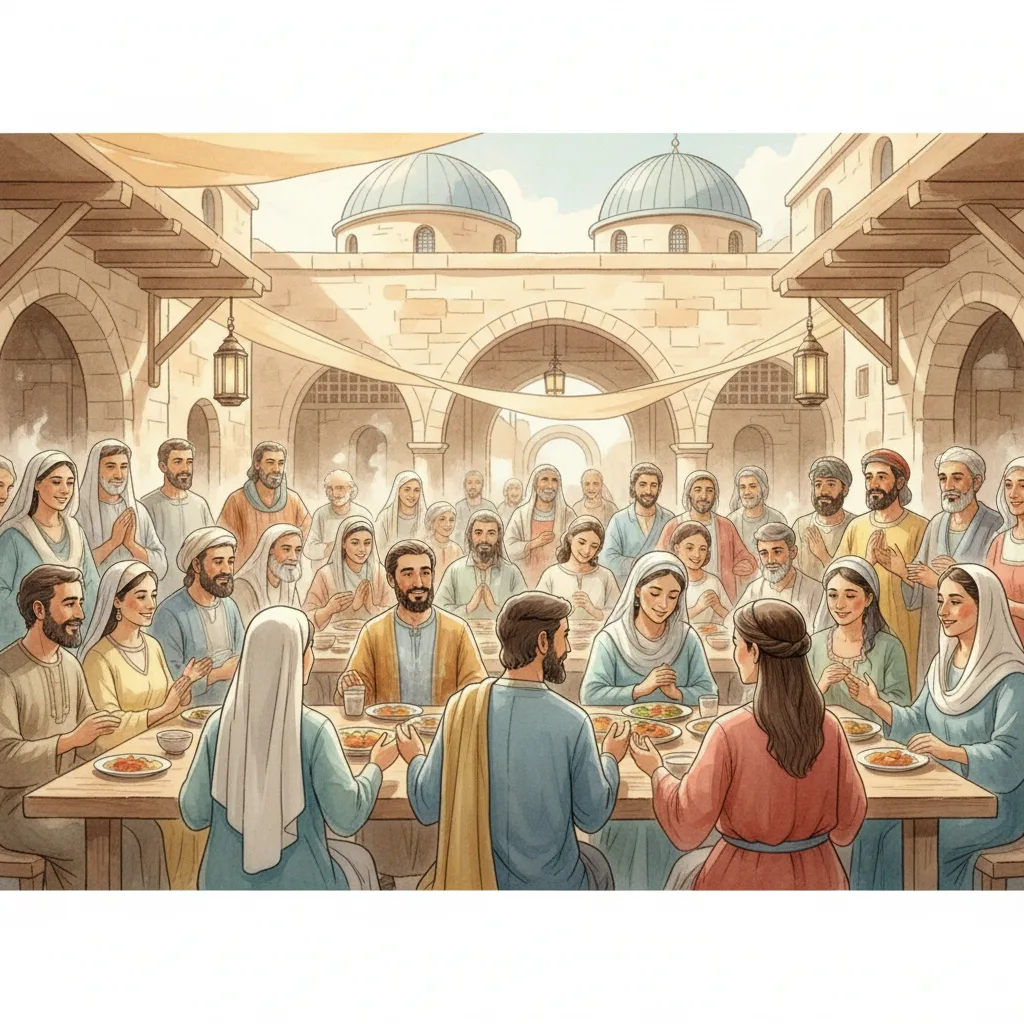
The "breaking of bread" here likely refers to their communal meals, which often included celebrating the Lord's Supper. In the ancient world, sharing a meal was an intimate act, a sign of deep bond and acceptance. For these early believers, it wasn't just sustenance; it was an expression of their unity in Christ, a practical manifestation of their fellowship, and a regular remembrance of Jesus' sacrifice.
In a world that often prizes individualism, the early church's commitment to profound fellowship stands as a powerful counter-narrative. Are we truly seeking out deep, meaningful relationships within our church communities? Are we willing to move beyond surface-level interactions to truly share our lives, our joys, and our struggles with one another?
And what about our shared meals? In a hurried culture, slowing down to share a meal can feel radical. Yet, it's in these moments of breaking bread, whether formal or informal, that bonds are forged, stories are shared, and the Spirit often ministers in tangible ways. It's a practice that invites us to embody the warmth and unity of the early church right around our own tables.
45 Selling their possessions and goods, they shared with anyone who was in need.
Luke then reveals a truly radical aspect of their community: they had everything in common, selling their possessions and goods to distribute to anyone who had need. This wasn't a mandated communist system, but a spontaneous, Spirit-prompted generosity that flowed from their deep love for God and for one another. They understood that their possessions were not ultimately their own, but were resources entrusted to them by God to be used for the good of the community.
This wasn't just about sharing a cup of sugar; it was about ensuring that no one among them lacked. The wealthy weren't hoarding; the poor weren't begging. There was a profound sense of mutual care and interdependence, a vivid demonstration of their belief that they were truly one family in Christ.
While this passage isn't prescriptive for a literal, across-the-board sharing of all personal property for us today, it certainly speaks to a foundational principle of Christian generosity and stewardship. It challenges us to ask: how tightly do we hold onto our possessions? Are we quick to identify and meet needs within our community and beyond?
The early church reminds us that our resources—our time, our talents, our finances—are not merely for our own comfort, but are tools God has given us to extend His kingdom and care for His people. A church that truly loves like the early church will have a profound impact on alleviating suffering and demonstrating God's provision in tangible ways.
And what about their daily rhythm? They continued to meet together in the temple courts and broke bread in their homes, eating together with glad and sincere hearts. This verse paints a beautiful picture of faith integrated into daily life. They worshipped publicly in the temple—a nod to their Jewish heritage and a sign of their bold witness—but also intimately in homes. This balance between large, corporate gatherings and smaller, personal fellowship was crucial.
Their meals were characterized by "glad and sincere hearts." This speaks to genuine joy and authentic transparency. There was no pretense, no performance; just a heartfelt celebration of God's goodness and their shared life together. This wasn't a duty; it was delight.
This rhythm provides an important model for us. We need the corporate worship experience—the grandeur of coming together as the body of Christ for teaching, singing, and prayer. But we also desperately need the intimacy of smaller gatherings—Bible studies, small groups, shared meals—where deeper relationships can form, where we can truly know and be known. Are we seeking this balance in our own spiritual lives?
Furthermore, are our gatherings, whether large or small, marked by "glad and sincere hearts"? Does our joy in Christ spill over into our interactions? Is there an authenticity, a transparency, a lack of pretense that invites others in? The early church wasn't just meeting; they were reveling in the presence of God and in each other's company.
Acts 2:47a
The result of these practices was striking: they were praising God and enjoying the favor of all the people. Their devotion, their fellowship, their generosity, and their heartfelt worship made them attractive to those outside their community. There was something compelling, something genuinely good about them that drew admiration and respect, even from those who didn't yet share their faith.
This isn't about being popular for popularity's sake. It's about living in such a way—displaying such love, joy, and integrity—that it becomes a powerful testimony to the transforming power of the gospel. When the church lives out its calling authentically, it naturally shines a light into the surrounding culture.
Does our church, does our individual witness, earn "favor with all the people" in a similar way? It doesn't mean we'll never face opposition, but it does mean our character and communal life should be undeniably winsome. Are we known for our genuine love, our practical care for the needy, our integrity, and our joy? These qualities, lived out consistently, are often the most powerful sermons we can preach without uttering a single word.
Acts 2:47b
Finally, the last phrase of our passage reveals the inevitable outcome of a church living in this manner: the Lord added to their number daily those who were being saved. Growth wasn't a program; it was a byproduct. It wasn't through slick marketing or human strategizing, but through the sovereign work of God, who honored their devotion, their love, and their witness.
This reminds us that evangelism is ultimately God's work, but He often uses the faithful obedience and vibrant community of His people as the conduit. When the church functions as God intended—centered on His Word, fueled by His Spirit, and characterized by genuine love—it naturally becomes a place where people encounter Christ and where His kingdom expands.
The Holy Spirit wasn't just an initial burst of power at Pentecost; He was the ongoing force animating their community, convicting hearts, and drawing people to saving faith. Their growth wasn't just in numbers, but in depth and spiritual vitality. This isn't to say that all churches must have numerical growth to be faithful, but it does suggest that when a church truly embodies the Acts 2 principles, God's Spirit is at work, and His kingdom will advance, however He chooses to measure it.
This challenges us to evaluate our own priorities. Are we genuinely seeking the Lord's hand in adding to our number, not just through our programs, but through the authentic, Spirit-filled life of our congregation?
Friends, the early church described in Acts 2 isn't some unattainable ideal from a bygone era. It's a living blueprint for the church in every age. It shows us that true spiritual vitality flows from a deep commitment to God's Word, authentic relationships, radical generosity, and sincere worship. It's a reminder that the church is not a building, or an event, but a Spirit-empowered community.
As we close, let's reflect on these markers. Where can we, as individuals and as a community, lean more fully into the principles Luke laid out for us? Let's pray for grace to cultivate such a faith—one that honors God, loves people, and shines brightly in our world.
25 Let us not neglect meeting together, as some have made a habit, but let us encourage one another, and all the more as you see the Day approaching.