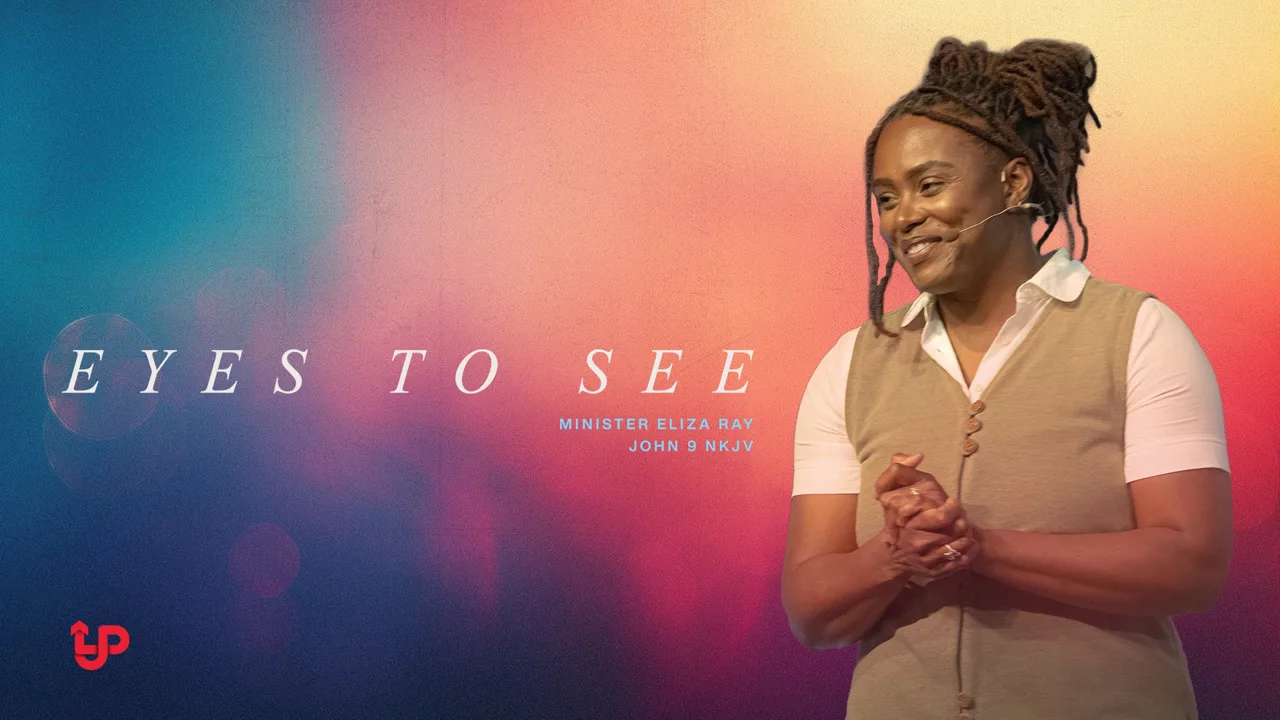
Eyes To See
Sermon notes from Minister Eliza Ray at Linked UP Church on seeing Jesus for who he truly is, reflecting his divine nature, and growing toward spiritual stability.
Eyes To See
Minister Eliza Ray
Linked UP Church
Building on Pastor Gregory’s Stability series, this message examines the spiritual impairment that hinders us from adding godly qualities to our faith.
4 Through these He has given us His precious and magnificent promises, so that through them you may become partakers of the divine nature, now that you have escaped the corruption in the world caused by evil desires.
Given the Divine Nature
God has given us all things that pertain to life and godliness through the knowledge of Christ. Being a partaker of his divine nature is not something we earn.
Nature speaks to our essence, temperament, instincts, and wiring. Through knowing Christ, we can share in the nature of God. It is remarkable that he wants us to be that united with him.
6 and to knowledge, self-control; and to self-control, perseverance; and to perseverance, godliness;
7 and to godliness, brotherly kindness; and to brotherly kindness, love.
Make Every Effort
Because God has given us his nature, we are empowered to add these qualities to our faith:
- Virtue
- Knowledge
- Self-control
- Perseverance
- Godliness
- Brotherly kindness
- Love
These are not merely good qualities. They reflect the divine nature of God.
Our Old Nature Is Not Our Excuse
We often identify with our old nature: “That’s just not me. I’m not like that.” But God has given us a new nature and a new way to be nurtured through his kingdom, his Word, and his love.
Minister Eliza described excusing a lack of diligence by saying she was simply a go-with-the-flow person. But our former temperament does not cancel what God has empowered us to become.
I am not who or what I used to be.
Fruit Others Can Taste
As these qualities grow in us, we become fruitful in our knowledge of the Lord.
Fruit is not only for us. Other people should be able to taste and see the goodness of God through our lives. Sour or spoiled fruit misrepresents the One whose name we bear.
This is not a call to condemnation. God shows us how to begin reflecting him.
The Diagnosis: A Sight Problem
Peter identifies the person who lacks these qualities as shortsighted, even to blindness, forgetting that they have been cleansed from their old sins.
The issue is not merely discipline. It is spiritual sight: failing to see who Christ is and what he has already done.
We continue walking in the old nature when we forget that we have been cleansed from it.
To Reflect Him, We Must See Him
Reflecting the divine nature requires seeing the divine nature.
Minister Eliza recalled Moses encountering God’s glory on the mountain. As God revealed himself, Moses saw with understanding. When he came down, his face reflected the glory he had seen.
That glory faded under the old covenant. In Christ, we are invited to behold the Lord with unveiled faces.
2 Moses alone shall approach the LORD, but the others must not come near. And the people may not go up with him.”
3 When Moses came and told the people all the words and ordinances of the LORD, they all responded with one voice: “All the words that the LORD has spoken, we will do.”
4 And Moses wrote down all the words of the LORD. Early the next morning he got up and built an altar at the base of the mountain, along with twelve pillars for the twelve tribes of Israel.
5 Then he sent out some young men of Israel, and they offered burnt offerings and sacrificed young bulls as peace offerings to the LORD.
6 Moses took half of the blood and put it in bowls, and the other half he sprinkled on the altar.
7 Then he took the Book of the Covenant and read it to the people, who replied, “All that the LORD has spoken we will do, and we will be obedient.”
8 So Moses took the blood, sprinkled it on the people, and said, “This is the blood of the covenant that the LORD has made with you in accordance with all these words.”
9 Then Moses went up with Aaron, Nadab and Abihu, and seventy of the elders of Israel,
10 and they saw the God of Israel. Under His feet was a work like a pavement made of sapphire, as clear as the sky itself.
11 But God did not lay His hand on the nobles of Israel; they saw Him, and they ate and drank.
12 Then the LORD said to Moses, “Come up to Me on the mountain and stay here, so that I may give you the tablets of stone, with the law and commandments I have written for their instruction.”
13 So Moses set out with Joshua his attendant and went up on the mountain of God.
14 And he said to the elders, “Wait here for us until we return to you. Aaron and Hur are here with you. Whoever has a dispute can go to them.”
15 When Moses went up on the mountain, the cloud covered it,
16 and the glory of the LORD settled on Mount Sinai. For six days the cloud covered it, and on the seventh day the LORD called to Moses from within the cloud.
17 And the sight of the glory of the LORD was like a consuming fire on the mountaintop in the eyes of the Israelites.
18 Moses entered the cloud as he went up on the mountain, and he remained on the mountain forty days and forty nights.
17 Now the Lord is the Spirit, and where the Spirit of the Lord is, there is freedom.
18 And we, who with unveiled faces all reflect the glory of the Lord, are being transformed into His image with intensifying glory, which comes from the Lord, who is the Spirit.
Seeing With Understanding
As we look upon Jesus with understanding, we are transformed into his image.
We see him through Scripture. The revelation of who he truly is reaches our hearts, and we begin to reflect him.
When we see him, we reflect him.
Look at Who He Is
Minister Eliza described repeatedly struggling with a sin and asking God why he still loved her. She recalled his response: she was focusing on what she was not instead of who he is.
Rather than looking only at our shortcomings, we can look to his victory. If we struggle to love, we can look at the love of God. Whatever the struggle, search the Scriptures to see how Jesus overcame.
See him with understanding, meditate on who he is, and reflect him.
John’s Signs Reveal Jesus
John presents Jesus’ miracles as signs. They point beyond the event itself to reveal who Jesus is.
Two encounters show a progression in spiritual sight: the man born blind and the woman at the well.
2 and His disciples asked Him, “Rabbi, who sinned, this man or his parents, that he was born blind?”
3 Jesus answered, “Neither this man nor his parents sinned, but this happened so that the works of God would be displayed in him.
4 While it is daytime, we must do the works of Him who sent Me. Night is coming, when no one can work.
5 While I am in the world, I am the light of the world.”
6 When Jesus had said this, He spit on the ground, made some mud, and applied it to the man’s eyes.
7 Then He told him, “Go, wash in the Pool of Siloam” (which means “Sent”). So the man went and washed, and came back seeing.
The Light Makes Sight Possible
When the disciples encountered a man born blind, they asked whose sin had caused his blindness. We also look for someone to blame in suffering, or assume our obedience should spare us from struggle.
Before healing the man, Jesus declared himself the light of the world.
Light is not merely helpful for seeing. It makes seeing possible. In the same way, Jesus is not merely helpful for spiritual life. He is the reason it is possible.
A Picture of Spiritual Blindness
Minister Eliza used the movement of light through the eye as a picture of spiritual understanding:
- A blockage prevents the light from entering.
- The light enters, but is not properly converted.
- The light passes through, but is not properly interpreted.
The picture asks whether we have fully received the light and understood who Jesus truly is.
The Clay and the Old Nature
Jesus made clay, placed it on the man’s eyes, and sent him to wash in the pool of Siloam.
Minister Eliza connected the dust to the formation of humanity, interpreting the clay as a picture of the old human nature obstructing spiritual sight.
Identifying only with our natural instincts or judging only by what we can see naturally hinders spiritual understanding. The man washed and returned seeing, echoing Peter’s warning about forgetting that we have been cleansed.
“A Man Called Jesus”
Asked how he received his sight, the healed man first described Jesus as a man.
His physical eyes were open, but his understanding of Jesus was still unfolding. Seeing Jesus only as a man is not yet seeing him in his glory.
“He Is a Prophet”
When questioned by the Pharisees, the man described Jesus as a prophet. His understanding was growing, but there was still more to see.
The religious leaders resisted the healing and called Jesus a sinner. The healed man challenged their conclusion, reasoning that what Jesus had done showed he was from God. They cast him out.
His physical healing was complete, while his spiritual sight continued to develop.
36 “Who is He, Sir?” he replied. “Tell me so that I may believe in Him.”
37 “You have already seen Him,” Jesus answered. “He is the One speaking with you.”
38 “Lord, I believe,” he said. And he worshiped Jesus.
“You Have Seen Him”
Jesus found the man after he had been cast out and revealed himself as the Son of God.
The man believed and worshiped. He now saw Jesus as more than a man or a prophet: the One worthy of honor, praise, and worship.
He had come to recognize the true light.
The Woman at the Well
The woman at the well experienced a similar progression without being physically blind.
First, she saw Jesus as a Jewish man asking for water. When he revealed his knowledge of her life, she recognized him as a prophet. Their conversation then turned to worship and the promised Messiah.
As she remembered the promise of the Messiah, Jesus revealed who he was.
Revelation Becomes Fruitfulness
The woman’s growing understanding led her to tell others about Jesus. She went into her town and invited people to come and see.
Her response moved beyond receiving information. Her worship became fruitful as she shared what she had encountered.
We need that same revelation of who Jesus truly is.
Thinking We Already See
Minister Eliza emphasized Jesus’ warning to the Pharisees: thinking we already see can keep us blind.
Attending church and reading the Bible do not remove our need for a deeper revelation of Christ. Has his light reached every part of our understanding?
Even where we have seen him, there is more of his glory to behold.
The Progression of Sight
- Not knowing who Christ is.
- Seeing him only as a man.
- Seeing him as a prophet.
- Remembering the Word and recognizing that he must be more.
- Seeing the divine in Christ.
The question is not simply whether we know about Jesus, but whether we see him for who he truly is.
Beyond a Transaction
We can acknowledge Jesus while approaching him only for what he can give us.
- We seek a good life, but he is life himself.
- We ask for provision, but he is the bread of life.
- We ask him to open doors, but he is the door.
We must see him as more than a means to an outcome. We are invited to know him.
He Is the Reward
Stability begins with seeing Jesus in his glory and beauty, not merely receiving a blessing and moving on.
The blessing is not the reward. He is.
The good things of this temporary life are not our final destination. We seek him for who he is, along with his righteousness and his kingdom.
Begin by Admitting the Need
Confessing that we do not see clearly is not a defeat. It opens the way to walk hand in hand with the Father as he reveals himself.
As we see Christ, we reflect his divine nature. That empowers us to grow in the qualities Peter describes and move toward a stable life.
Prayer: Open Our Eyes
Father, help us see you for who you truly are. Do not let us stop at seeing Jesus as only a man or a prophet.
There are areas where we do not see you clearly. Reveal yourself through your Word, that we may see you, reflect you, and know you.
Help us love you and long for you more than anything else in this life.
Receive the Light
The message closed with invitations to:
- Receive Jesus as Lord and Savior.
- Repent and rededicate your life to the Lord.
- Receive baptism in the Holy Spirit with the evidence of speaking and praying in new tongues.
- Join Linked UP Church and be nurtured in the truth of God’s Word.
The invitation was to come without fear or hindrance and receive prayer.
Prayer of Surrender
Father, I confess that I am a sinner, that I was born blind, but I need the light. I need your Son, Jesus, that I may see.
Lord, I receive you as my Lord and Savior, to rule over me and my life all the days of my life. I thank you that since I have asked, I have received.
In Jesus’ name I pray. Amen.