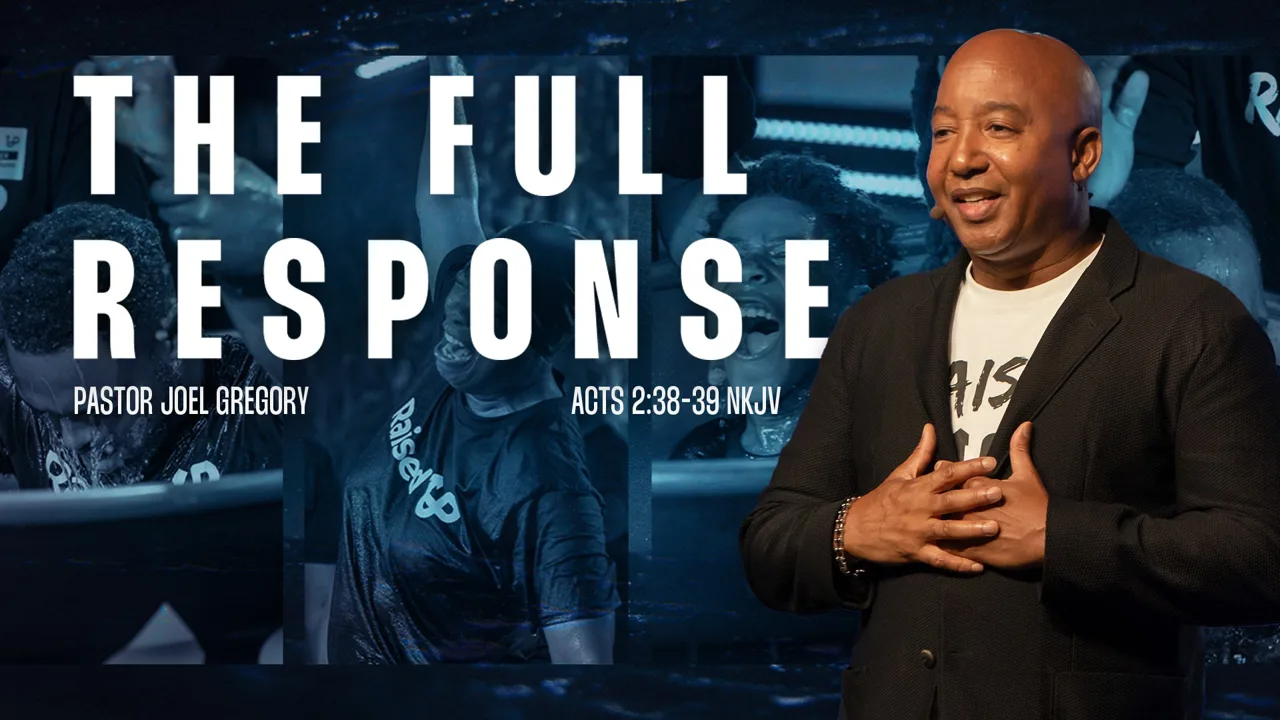
The Full Response
Sermon notes from Pastor Joel Gregory at Linked UP Church on receiving salvation, being filled with the Holy Spirit, and publicly declaring faith through water baptism.
The Full Response
Pastor Joel Gregory | Linked UP Church
On Water Baptism Sunday, roughly 150 people had preregistered across the day's services. Pastor Gregory invited the church to believe God for more than 200 baptisms, including spontaneous responses.
This message also expresses the church's vision: what it believes and how it will operate.
A Response to the Gospel
Acts 2 begins with believers gathered in the upper room. The Holy Spirit came upon them, and they began speaking in other tongues. Those who gathered heard them speaking in their own languages.
Peter preached about Jesus Christ. The listeners were convicted in their hearts and asked what they should do.
They did not merely attend a meeting. They responded to the gospel.
38 Peter replied, “Repent and be baptized, every one of you, in the name of Jesus Christ for the forgiveness of your sins, and you will receive the gift of the Holy Spirit.
39 This promise belongs to you and your children and to all who are far off—to all whom the Lord our God will call to Himself.”
Three Connected Experiences
Peter's answer pointed to three life-changing experiences:
- Repent and receive Jesus Christ.
- Be water baptized.
- Receive the gift of the Holy Spirit.
The promise was for those listening, their children, and all whom God would call.
These experiences are connected, but they are not identical. Salvation gives us new life. The Holy Spirit empowers us to live that life. Water baptism publicly declares that we belong to Jesus.
Do Not Stop Short
At salvation, the Holy Spirit comes to live within the believer. Pastor Gregory distinguished this from the empowering experience of the Holy Spirit coming upon the believer.
Water baptism is a public declaration that Jesus Christ is Lord. Like a wedding ring publicly identifies a marriage, baptism identifies our relationship with Jesus.
God does not want us to stop short of everything He has provided. He invites us to make a full response.
1. Get Saved: Receive New Life
Salvation is where our relationship with God begins. Peter preached the death and resurrection of Jesus, and the people were convicted.
To repent means to change your mind, turn from sin, and turn toward God. Salvation occurs when we place our faith in Jesus Christ, believing that He died for our sins and that God raised Him from the grave.
We are not saved by attending church, doing good works, or trying to improve ourselves. We are saved by grace through faith in Jesus Christ.
Faith Responds to Grace
Grace is what God has done for us, not something we have done for ourselves. Our faith responds to what His grace has provided.
There are not many ways to God. Salvation is through His Son, Jesus Christ.
Salvation Is Personal
You can become a better person without becoming a new person. When you receive Jesus, God does not merely improve your old life. He gives you new life.
Being around saved people does not make you saved. Sitting in church does not make you a Christian any more than sitting in a garage makes you a car. Your family's faith cannot replace your own response to Jesus.
The greater question is not whether you go to church, but whether you have received Jesus Christ as your Lord and Savior.
Pastor Gregory shared his wife's question: not simply whether you went to church, but whether the church went home with you. What leaves with you reveals who you really are.
2. Be Filled: Receive Power for Your New Life
God does not save us and then leave us to live the Christian life in our own strength.
Jesus told His disciples to wait in Jerusalem until they received power from on high. They already believed in Him, but they needed the Holy Spirit's empowerment before going out as His witnesses.
Many believers struggle because they are trying to live for Jesus without depending on that power.
Power to Be a Witness
Pastor Gregory explained the word dunamis as power, force, and miraculous ability. The Holy Spirit comes upon believers to empower them to testify about Jesus.
This is not merely trying harder in our own ability. The power must be present to support what we do in Jesus' name.
Cooperate With the Holy Spirit
They were all filled with the Holy Spirit, and they began to speak. The Spirit gave the utterance.
The Holy Spirit does not force a person to speak. The believer must cooperate, yield their vocal cords, and receive what the Spirit gives.
Pastor Gregory emphasized that all were filled, not merely a few. This empowerment is for every believer.
Empowered for the Assignment
The Holy Spirit gives believers:
- Power to witness.
- Strength to overcome temptation.
- Boldness to represent Jesus.
- Spiritual ability to fulfill their assignment.
Pastor Gregory credited the Holy Spirit's empowerment for sustaining him through 33 years of ministry. He emphasized that the congregation needs more than his natural ability; it needs a man anointed by God to deliver God's Word.
God will not give you an assignment without empowering you to fulfill it.
The Believers in Samaria
Philip preached the kingdom of God and the name of Jesus Christ in Samaria. Men and women believed and were baptized.
The order matters: they believed first, then they were water baptized. Baptism is not a substitute for receiving Jesus.
15 On their arrival, they prayed for them to receive the Holy Spirit.
16 For the Holy Spirit had not yet fallen upon any of them; they had simply been baptized into the name of the Lord Jesus.
17 Then Peter and John laid their hands on them, and they received the Holy Spirit.
God Still Had More for Them
When the apostles in Jerusalem heard that Samaria had received God's Word, they sent Peter and John. These believers had been baptized, but the Holy Spirit had not yet fallen upon them.
Peter and John prayed and laid hands on them, and they received the Holy Spirit.
Pastor Gregory's distinction was that salvation brings us into relationship with God and secures heaven, but believers also need power to live on earth. The Holy Spirit is not a reward for spiritually perfect people. He is God's gift to believers.
Do Not Live on Your Own Strength
Trying to live for Jesus without depending on the Holy Spirit is like trying to drive a car without fuel. The car may look good, have potential, and have a destination, but it still needs power.
You may want to witness but struggle with fear. You may want to pray but not know what to say. The Holy Spirit comes alongside you and helps you pray according to God's will.
Your ability is limited. The Holy Spirit is unlimited.
3. Be Water Baptized: Declare Your New Life
Water baptism is the outward expression of an inward decision. It does not replace faith in Jesus, and the water itself does not save. We are saved by grace through faith.
Baptism is an act of obedience that publicly identifies us with the death, burial, and resurrection of Jesus Christ.
- Going beneath the water represents the burial of the old life.
- Coming out of the water represents new life in Christ.
It declares that Jesus is Lord, that we belong to God's family, and that we are not ashamed to follow Him.
The Ethiopian Official
Philip shared the gospel with an Ethiopian official. When the man understood the message about Jesus and saw water, he wanted to be baptized immediately.
Before baptizing him, Philip confirmed his faith. The man's personal belief in Jesus came before his baptism.
38 And he gave orders to stop the chariot. Then both Philip and the eunuch went down into the water, and Philip baptized him.
Personal Faith, Clear Confession, Immediate Obedience
The Ethiopian official did not ask for six months to think about it or say he had brought the wrong clothes. His faith was personal, his confession was clear, and his obedience was immediate.
Pastor Gregory also challenged believers not to postpone a person's response to salvation until a future church service when they can share the gospel in the present moment.
Sometimes delayed obedience becomes disobedience. When God makes the next step clear, the right time to obey is now.
Have You Been Baptized Since You Believed?
Perhaps you received Jesus years ago but have not been water baptized. Perhaps you were baptized as a child before personally understanding salvation. Perhaps you recently gave your life to Christ.
Water baptism is an opportunity to make your own public declaration that you believe in Jesus Christ and are not ashamed to belong to Him.
The Household of Cornelius
While Peter was still speaking, the Holy Spirit fell upon those hearing the Word. The Jewish believers with Peter were astonished that Gentiles also received this gift.
They recognized what had happened because they heard them speak with tongues and magnify God.
Peter then called for them to be water baptized. Receiving the Holy Spirit did not remove the need for that public response.
45 All the circumcised believers who had accompanied Peter were astounded that the gift of the Holy Spirit had been poured out even on the Gentiles.
46 For they heard them speaking in tongues and exalting God. Then Peter said,
47 “Can anyone withhold the water to baptize these people? They have received the Holy Spirit just as we have!”
48 So he ordered that they be baptized in the name of Jesus Christ. Then they asked him to stay for a few days.
The Full Response
The household of Cornelius:
- Believed the gospel.
- Received the Holy Spirit.
- Were water baptized.
The message is clear: God wants to save you, fill you, and have you publicly identify with Jesus.
What Is Stopping You?
Pastor Gregory asked everyone in the room and watching online to answer three questions:
- Have you received Jesus as your Savior? Turn from sin, believe the gospel, and surrender your life to Jesus.
- Have you received the empowering fullness of the Holy Spirit? You do not have to live the Christian life in your own strength.
- Have you been baptized since you believed? If you have received Jesus but have not been water baptized, what is stopping you?
An Invitation to Respond
The closing invitation included four responses:
- Receive Jesus Christ as Lord and Savior.
- Repent and return to Christ after walking away from Him.
- Receive the baptism of the Holy Spirit, with the biblical evidence of praying in other tongues.
- Respond immediately through water baptism.
For those who had not planned to be baptized, the church had prepared clothing, hair caps, socks, towels, and other supplies. People came forward for spontaneous baptism.
Making the Decision for Yourself
Pastor Gregory shared that he attended Catholic schools as a child, although his family was not Catholic. He was sprinkled during a school baptism but later recognized that he had not personally understood or chosen that response.
After giving his life to Christ at age 22, he chose to be water baptized by immersion. He explained baptism as going fully beneath the water and coming back out.
He invited those with a similar experience to make their own response. More people came forward as he continued asking: What is hindering you?