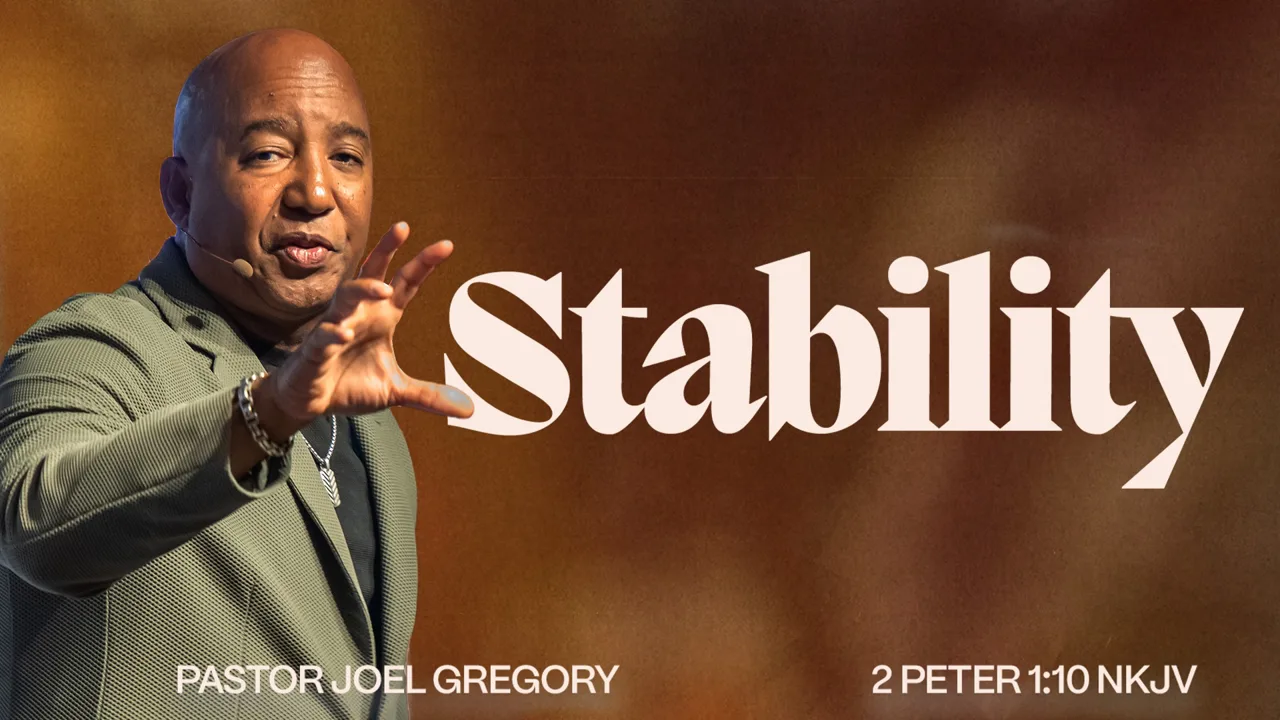
Stability Part 2
Sermon notes from Pastor Joel Gregory at Linked UP Church on building a stable life through faith, virtue, and knowledge.
Stability Part 2
Pastor Joel Gregory · Linked UP Church
Building a life that won't stumble.
God doesn't just want you saved. He wants you stable. Salvation gives us new life, but spiritual maturity teaches us how to live that life.
3 His divine power has given us everything we need for life and godliness through the knowledge of Him who called us by His own glory and excellence.
4 Through these He has given us His precious and magnificent promises, so that through them you may become partakers of the divine nature, now that you have escaped the corruption in the world caused by evil desires.
5 For this very reason, make every effort to add to your faith virtue; and to virtue, knowledge;
6 and to knowledge, self-control; and to self-control, perseverance; and to perseverance, godliness;
7 and to godliness, brotherly kindness; and to brotherly kindness, love.
8 For if you possess these qualities and continue to grow in them, they will keep you from being ineffective and unproductive in your knowledge of our Lord Jesus Christ.
9 But whoever lacks these traits is nearsighted to the point of blindness, having forgotten that he has been cleansed from his past sins.
10 Therefore, brothers, strive to make your calling and election sure. For if you practice these things you will never stumble,
You Will Never Stumble
Peter is writing to believers who have faith but are stumbling through life. He teaches them to add some things to their faith.
We usually stumble before we fall. Peter says that if we develop these qualities, we will not even stumble.
Don't bring God's promise down to the level of your experience. Receive what he said by faith.
Eight Qualities That Produce Stability
- Faith
- Virtue
- Knowledge
- Self-control
- Perseverance
- Godliness
- Brotherly kindness
- Love
These believers already had faith. Peter tells them what to add to it.
God Has a Next for You
Seven represents completion in Scripture. Eight represents what comes next: a fresh start or a new cycle.
Eight people came through the flood in Noah's ark and stepped into a fresh start. Circumcision on the eighth day marked the beginning of a boy's covenant with God.
As long as you are breathing, God has a next for your life. Get before him and find out what it is. Your next can be greater than the season you just came out of.
What Is Stability?
Stability is the ability to remain firm, consistent, balanced, and established even when circumstances around you change.
A stable believer is not someone who never experiences trouble. A stable believer has learned how to remain standing when trouble comes.
Spiritual stability is not accidental. It must be developed.
4 Through these He has given us His precious and magnificent promises, so that through them you may become partakers of the divine nature, now that you have escaped the corruption in the world caused by evil desires.
5 For this very reason, make every effort to add to your faith virtue; and to virtue, knowledge;
The Foundation of Stability
Faith, virtue, and knowledge.
Before you can stand against what is around you, you must first develop what is within you.
God has already given you what you need.
God Has Already Supplied It
Notice the words has given. They are past tense. Peter does not say God will eventually give you what you need.
Through Christ's death, burial, and resurrection, God has already supplied what we need for life and godliness.
Godliness is Godlikeness. Life speaks of the God kind of life, life as God intended it.
Sometimes we spend our lives asking God for things he says he has already provided.
12 I know how to live humbly, and I know how to abound. I am accustomed to any and every situation—to being filled and being hungry, to having plenty and having need.
Learn Contentment
Paul learned how to live with plenty and how to live with little. He learned contentment.
Whether you have everything you are believing for or not, God is still good.
Do not become so focused on what you do not have that you cannot appreciate what God has already given you. Take time to thank him for what you have.
Develop an “I Can Do” Attitude
You can accomplish what God puts before you, not through your ability alone, but through Christ.
Christ speaks of the Anointed One and his anointing. If you are born again, the Holy Spirit lives within you.
To strengthen means to empower, enable, increase in strength, and make strong. The Holy Spirit strengthens you from within.
Strengthened on the Inside
Every time you study God's Word, you are being strengthened within. Praying in the Holy Spirit builds you up in faith.
Instead of continually talking about how tired you are or how hard life is, recognize your need to recharge.
The Greater One Is Within You
John's context includes false prophets and the spirit of antichrist. The world's system is opposed to God, but believers have overcome it.
To overcome means to subdue, conquer, prevail, and gain the victory.
What God has put inside you is greater than what is operating in the world. Do not let fear of the economy, interest rates, or the world's financial system determine what you believe God can do.
Develop What God Supplied
Stability begins with recognizing: I am not trying to become equipped. In Christ, I have been equipped.
God has supplied his Word, his Spirit, grace, faith, authority, power, and wisdom. Our responsibility is to develop and use what he has supplied.
The better question is not simply, “What will God give me?” It is, “What has God already provided that I need to develop?”
Faith Stabilizes What You Believe
Faith is confidence in God's character, trust in God's Word, and corresponding action based on what God said.
Faith says: God said it. I believe it. Therefore, I will order my life accordingly.
Substance and Evidence
Faith is present confidence concerning what you expect to receive.
Substance speaks of support, confidence, and reality. It gives what you believe stability.
Evidence speaks of proof or conviction. That conviction should come from God's Word.
A delivery notice gives you confidence that your package is waiting even though you cannot see it. In the same way, find the evidence in God's Word for what you are believing to receive.
Keep Hearing the Word
You can keep hearing what God says. Speak his Word yourself and listen to it.
Raise your attention to God's Word to meet the challenge before you. When facing sickness, feed on teaching about healing. When facing financial lack, feed on what God's Word says about provision.
This is not a game. The enemy seeks to steal, kill, and destroy.
Faith Acts Like an Anchor
Circumstances change. Feelings change. People's opinions change. God's Word does not change.
An anchor does not stop the storm. It stops the storm from deciding where the ship ends up.
Faith does not mean storms never come. Faith says, “This storm will not determine where my life ends up.”
Where Are Circumstances Speaking Louder?
Identify an area where you talk more about your circumstances than about God's Word.
Ask: What has God said about this?
- Find the promise.
- Meditate on it.
- Speak it.
- Believe it.
- Act on it.
Stable people build their convictions around God's Word, not their circumstances.
Virtue Stabilizes Your Character
Virtue means moral excellence, integrity, courage, and excellence of character.
Faith concerns what you believe. Virtue concerns who you are becoming.
The first thing Peter tells believers to add to their faith is not a car, a house, or more money. It is virtue.
Your heavenly Father is concerned about the person you are becoming. Poor character can hinder what you are believing to receive.
A Father's Provision
Pastor Gregory described promising his daughter a vehicle when she graduated from college. She trusted his promise enough to send pictures of what she wanted while she was still a sophomore.
Her responsibility was to develop her character and pursue her education. Her father's provision did not remove those responsibilities.
When she graduated, he transferred the money to her account so she could purchase the vehicle herself with cash and experience operating without financing it.
Integrity Creates Security
A person who walks in integrity does not have two characters to support: one on Sunday and another for the rest of the week.
A person who constantly has to hide things cannot live completely stable.
You cannot live on two roads, with a Sunday faith and a worldly life, and expect stability.
8 He is a double-minded man, unstable in all his ways.
Stand on Your Integrity
Pastor Gregory recalled a season when he and his wife faced accusations they could not control. His response was, “Heaven will judge this correctly.”
You cannot control everything people say about you. You can live the life in front of you and stand on your integrity.
Don't let your faith take you somewhere your character cannot keep you.
Great faith can take someone to the mountaintop, but undeveloped character can bring that person down.
8 But he refused. “Look,” he said to his master’s wife, “with me here, my master does not concern himself with anything in his house, and he has entrusted everything he owns to my care.
9 No one in this house is greater than I am. He has withheld nothing from me except you, because you are his wife. So how could I do such a great evil and sin against God?”
Joseph: Integrity When No One Is Watching
Joseph refused the advances of his master's wife. His concern went beyond being caught or disappointing people. He recognized that the act would be sin against God.
Integrity is who you are when nobody else is watching.
Sometimes doing the right thing still brings unjust treatment. Joseph was put in prison, yet the Lord remained with him and he continued to receive favor.
Do Not Let the Situation Change Your Character
Joseph's circumstances did not cancel God's presence or his future. God did not waste the process.
Instead of asking only, “Why me?” ask, “God, what do you want me to learn through this?”
Jesus also suffered for things he did not do. Living by faith with strong character does not mean you will never be treated unjustly.
Keep your heart right. Do not let the situation change your character.
The Private Life Test
Is there anything in your private life that could eventually destabilize your public life?
- Relationships or conversations
- Spending
- Sexual temptation or internet activity
- Dishonesty
- Pride or bitterness
You cannot manage compromise. You must eliminate it.
Knowledge Stabilizes Your Decisions
Peter tells believers to add knowledge to virtue.
You need faith. You need character. You also need the right information, both spiritual and natural.
Being God's person does not remove the need to learn.
Do Not Reject Knowledge
In this passage, God addresses priests who were responsible for teaching the people but were rejecting knowledge themselves.
The people were not destroyed because they were not God's people. They were God's people who lacked knowledge.
Rejecting God's Word is rejecting God. What we receive and teach matters, including its effect on our children.
Get Understanding
Wisdom is first in rank and order. Make God's Word first in your life.
Understanding is the ability to apply what you have learned. Having information is not the same as knowing how that information works.
Pastor Gregory challenged the congregation to examine the gap between what they believe God has provided and what they understand how to put into practice, including finances, health, and marriage.
Learn How to Do It
Pastor Gregory shared that he and his wife had about a quarter-million dollars remaining in debt on a car and a house. When they believed God directed them to use real estate to become debt-free, they first pursued education.
His wife became an agent and later a broker. He completed a six-week real estate investment course around his work schedule.
He described becoming debt-free two and a half years later. Faith and character needed to be joined with the knowledge and understanding to act.
Power Needs Direction
Anything you want to do in life requires learning how to do it. You cannot simply say what you want to become and refuse to develop.
A powerful automobile is not enough if you have no idea where you are going. You can move quickly and still go nowhere.
Busyness is not the same as progress. Power without direction can get you lost faster.
Ask What Wisdom Says
Before making a major decision, develop the habit of asking, “What does God's Word say about this?”
- Before choosing a relationship
- Before making a financial decision
- Before responding to conflict
- Before making a career move
- Before making a major purchase
Do not just ask what you want to do. Ask what wisdom says you should do. Rather than choosing your own way and asking God to bless it, seek his wisdom first.
Stability Check
Faith
What am I believing? Where am I getting my information?
Virtue
Who am I becoming? Where am I compromising?
Knowledge
What do I need to learn, both spiritually and naturally?
Declaration
My faith is established in God's Word.
My character will reflect Christ.
My decisions will be governed by wisdom.
I am building a stable life in Jesus' name.
Amen.
Building a Stable Life Starts With Christ
Pastor Gregory closed with three invitations:
- Receive Christ: Begin a personal relationship with God through Jesus Christ, confessing him and believing that God raised him from the dead.
- Rededicate your life: Repent of living on two roads and return to fellowship with God.
- Find a church home: Join Linked UP Church if you believe God has led you there.