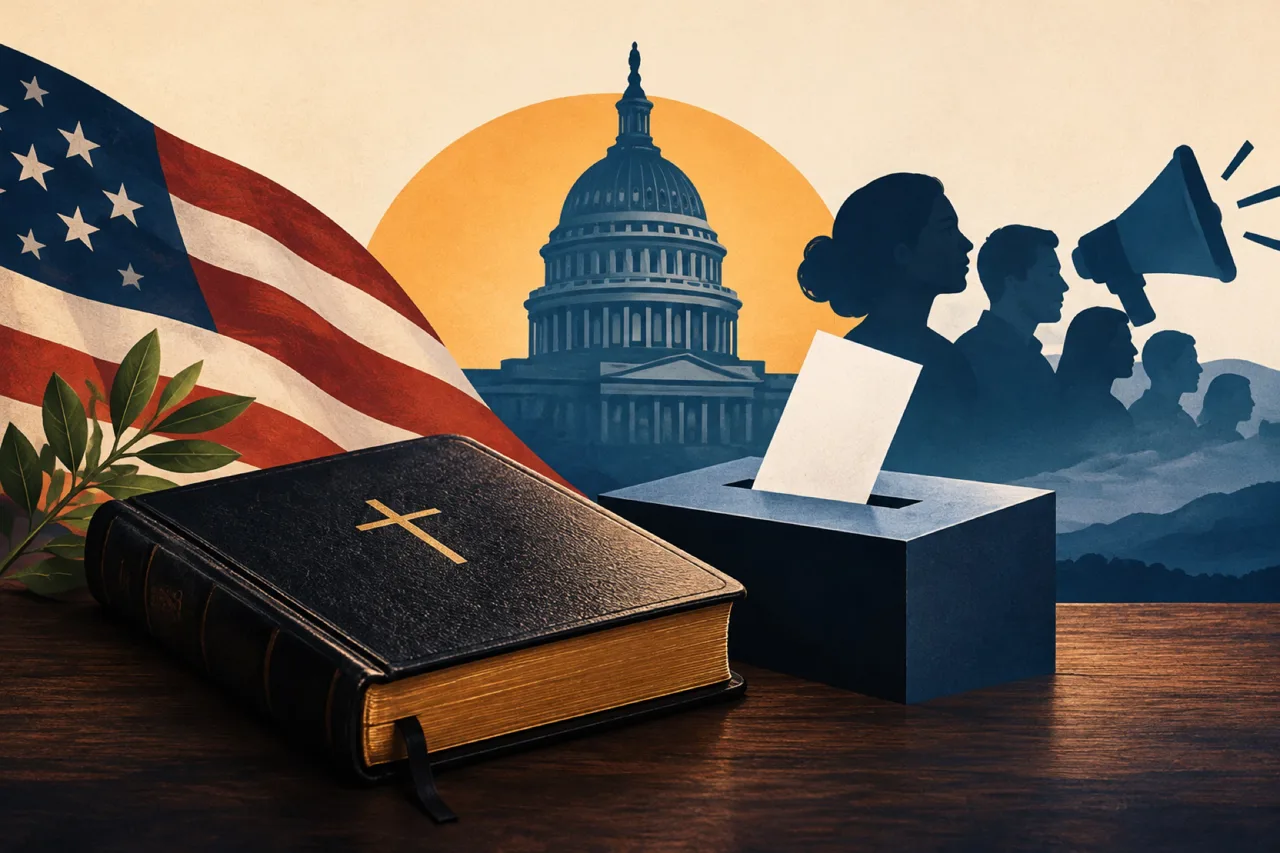
Faith, Voting, and Speaking Up
A personal conversation about voting through a biblical worldview, changing political loyalties, protecting life, and the responsibility to speak with conviction beyond an election.
How we approached this election
After a wild election season and Donald Trump's victory, we wanted to sit down and process how we voted and why.
This is our perspective, not a claim that every Christian reached the same conclusion. We want to explain the convictions behind our decision and why we believe our responsibility continues after Election Day.
Our starting point is Scripture
We approach political questions through what we understand to be a biblical worldview. We believe God's Word is living and applicable beyond the time in which it was written.
We try to understand Scripture first, then consider how the choices before us line up with it. That requires honesty about the text, the culture, and our own assumptions.
Values before party loyalty
Our vote belongs to neither party automatically. We weigh the available choices against our convictions and decide which concerns carry the greatest weight.
That means our vote could change in a future election. If a party changes direction, we have to be willing to reassess our support.
Our political support changed
We supported Barack Obama during his first campaign and into his second term. His ability to communicate, the hope surrounding his campaign, and the historical significance of his election mattered to us.
During his second term, we became increasingly uncomfortable with the direction of his administration and the Democratic Party, particularly on sexuality and gender. Our support changed because we believed those policies conflicted with our convictions.
Why we voted Republican this time
In this election, we believed the Republican Party was the only viable option we could support. Abortion, our understanding of male and female, and the protection of children weighed heavily in that decision.
That does not mean we consider Republicans faultless. It means these issues were decisive for us in comparing the available choices.
Our understanding of male and female
Genesis grounds our belief that God created humanity male and female. That conviction shapes how we evaluate policies involving gender, schools, sports, and parental responsibility.
We recognize that other people understand these questions differently. We are explaining the biblical conviction that guided our vote, not offering a clinical explanation of anyone's identity or experience.
Accountability includes our own side
We have friends and family who share our faith but voted differently. Our challenge is this: whatever party you support, be willing to confront what you believe is wrong within it.
We have to accept that challenge ourselves. Political support should never require silence about a candidate's failures or a party's policies.
An election is not the end of the work
A political victory does not automatically change a culture. The concerns that shaped our vote do not disappear because our preferred candidate wins.
We believe lasting change requires the church to pray, teach, serve, and speak. We were encouraged by Christians who fasted, interceded, and participated rather than remaining on the sidelines.
Why abortion was decisive for us
Our conviction is that unborn human life deserves protection from its beginning. We regard abortion as the taking of innocent human life, not simply one policy question among many.
The command against murder is central to our reasoning. We read it alongside passages describing God's knowledge and formation of a child in the womb.
14 I praise You, for I am fearfully and wonderfully made. Marvelous are Your works, and I know this very well.
15 My frame was not hidden from You when I was made in secret, when I was woven together in the depths of the earth.
16 Your eyes saw my unformed body; all my days were written in Your book and ordained for me before one of them came to be.
Support does not mean full agreement
Our opposition to abortion also leads us to disagree with Donald Trump where his position allows it. We do not consider a position fully pro-life simply because it is more restrictive than another candidate's.
Voting for someone does not remove our responsibility to challenge that person. The same standard must apply after the election.
Pregnancy made this personal
Being pregnant during this conversation made the issue especially immediate for Rhoda. Nausea, exhaustion, and other changes were reminders to her that a child was developing before a pregnancy became visibly obvious.
For us, the child's value does not depend on visibility, stage of development, or location inside or outside the womb.
Take the language seriously
We are concerned that political language can hide the moral questions underneath it. A phrase can sound compassionate while leaving important consequences unexamined.
Our responsibility is to look beyond a slogan and ask what a policy actually permits, whom it affects, and whether we can support it in good conscience. That scrutiny should apply to both parties.
Protection must include practical support
Some people face pregnancy while feeling frightened, pressured, or unable to raise a child. Those circumstances deserve serious attention, not dismissal.
In our conversation, we pointed to adoption, church support, pregnancy assistance, food programs, and other nonprofit services as possibilities to explore. Their availability varies, but we believe protecting unborn life must include helping the mother and family.
We also recognize that some people have experienced abortion under pressure or without fully understanding their options.
A spiritual concern about vulnerable lives
We understand these questions as spiritual as well as political. John 10:10 shaped our discussion of destruction and the life Jesus gives.
Our concern is the vulnerability of children and our responsibility to protect them. That conviction should direct our actions toward protection and care.
Children are not expendable
Jesus' warning about causing little ones to stumble carries tremendous weight for us. We also return to the Psalms' description of children as a heritage from the Lord and as arrows in a young man's hand.
These passages shape our conviction that children should be welcomed, protected, and raised with responsibility.
4 Like arrows in the hand of a warrior, so are children born in one’s youth.
Faithfulness in a troubled world
We referred to Philippians as a call for believers to live faithfully in the middle of a corrupt world. We also referred to Jesus' instruction not to despise little ones.
For us, these are reasons to take both our conduct and the treatment of children seriously.
16 as you hold forth the word of life, in order that I may boast on the day of Christ that I did not run or labor in vain.
We cannot know a child's whole future
A difficult beginning does not tell us everything about the life ahead. We do not believe hardship or uncertain circumstances make a human life less valuable.
Ecclesiastes reminded us of the limits of our understanding. We do not fully comprehend God's work in the formation of life, and that calls us to humility rather than certainty about another person's future.
The convictions behind our vote
- We believe abortion takes innocent human life.
- We believe male and female are meaningful distinctions in God's creation.
- We believe parents have a responsibility to raise and protect their children.
- We believe children should be protected from sexualization and exploitation.
These convictions, rather than unconditional loyalty to a politician, explain our choice.
Questioning what God has said
We returned to the temptation in the garden as a picture of how doubt about God's instruction can lead to disobedience.
That story challenges us to examine whether we are listening to Scripture or reshaping it around what we already want. We must be willing to examine ourselves, not only the people with whom we disagree.
2 The woman answered the serpent, “We may eat the fruit of the trees of the garden,
3 but about the fruit of the tree in the middle of the garden, God has said, ‘You must not eat of it or touch it, or you will die.’”
4 “You will not surely die,” the serpent told her.
5 “For God knows that in the day you eat of it, your eyes will be opened and you will be like God, knowing good and evil.”
6 When the woman saw that the tree was good for food and pleasing to the eyes, and that it was desirable for obtaining wisdom, she took the fruit and ate it. She also gave some to her husband who was with her, and he ate it.
Purpose and responsibility
Near the close of our conversation, we pointed to Mary receiving the announcement of Jesus' birth as part of our reflection on children, purpose, and responsibility.
We believe each of us also has responsibilities in the time and place where God has put us. Whether we work in politics, a business, a home, or another setting, faith should shape how we act.
27 to a virgin pledged in marriage to a man named Joseph, who was of the house of David. And the virgin’s name was Mary.
28 The angel appeared to her and said, “Greetings, you who are highly favored! The Lord is with you. ”
29 Mary was greatly troubled at his words and wondered what kind of greeting this might be.
30 So the angel told her, “Do not be afraid, Mary, for you have found favor with God.
31 Behold, you will conceive and give birth to a son, and you are to give Him the name Jesus.
32 He will be great and will be called the Son of the Most High. The Lord God will give Him the throne of His father David,
33 and He will reign over the house of Jacob forever. His kingdom will never end!”
34 “How can this be,” Mary asked the angel, “since I am a virgin?”
35 The angel replied, “The Holy Spirit will come upon you, and the power of the Most High will overshadow you. So the Holy One to be born will be called the Son of God.
36 Look, even Elizabeth your relative has conceived a son in her old age, and she who was called barren is in her sixth month.
37 For no word from God will ever fail. ”
38 “I am the Lord’s servant,” Mary answered. “May it happen to me according to your word.” Then the angel left her.
Conviction needs understanding
Speaking boldly is not enough. We need to understand what we are reading and the circumstances we are addressing.
Do not confuse zeal with knowledge. Read carefully, consider context, and be honest about the limits of your understanding. Then speak from conviction rather than merely repeating a party's message.
Our responsibility continues
The election is over. The work of faithfulness is not.
We want to model for our children a willingness to do what we believe is right, even when speaking is inconvenient. We also want to keep testing our understanding against Scripture and holding the people we support accountable.
May God give us understanding, conviction, courage, and the willingness to obey.