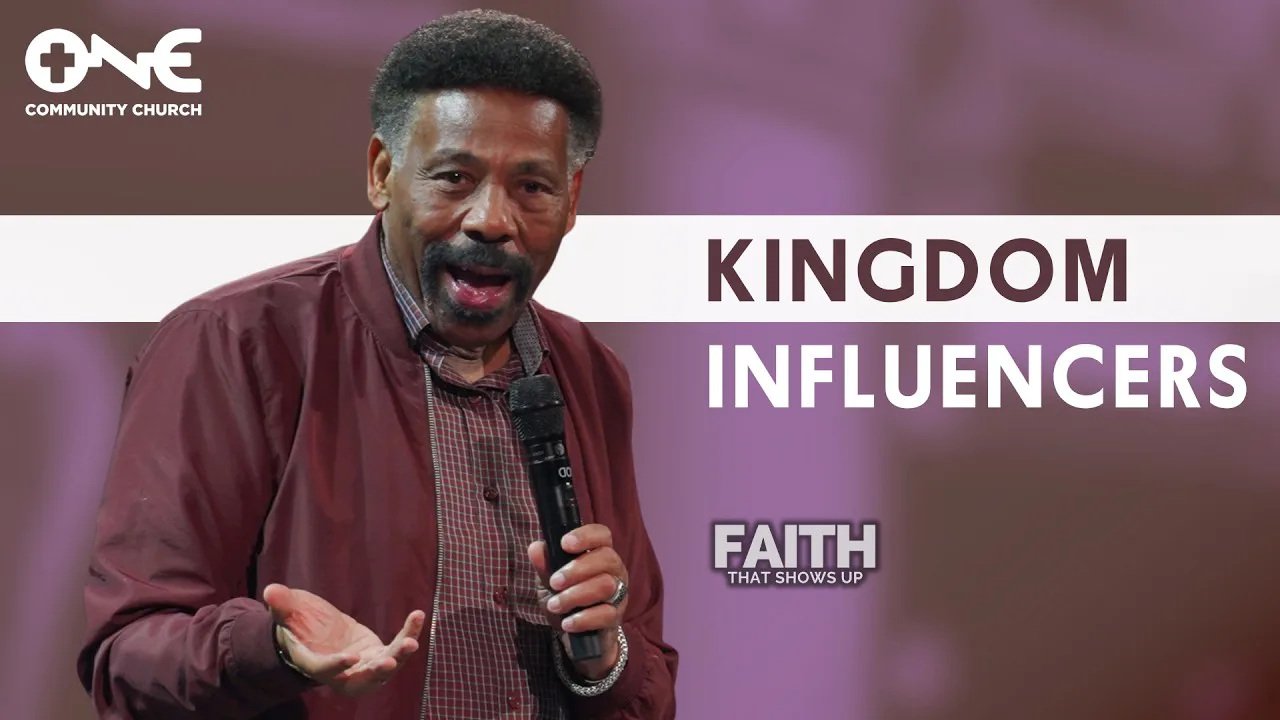
The Difference Between Good Things and Good Works
Sermon notes from Dr. Tony Evans at One Community Church on salt, light, and the difference between doing good things and doing good works that glorify God.
A Faith That Shows Up
Dr. Tony Evans opens with a prayer that his words would be acceptable to God and encourage a faith that shows up: making visible the belief in Christ that believers share.
Kingdom Influencers
Social influencers gather an audience around an opinion, a perspective, or a product. Politicians seek influence so people will buy into their platforms.
God also has a passion for influence. He wants people who act on his behalf, bringing others into the knowledge and experience of him.
In the Sermon on the Mount, Jesus uses two pictures to describe this calling: salt and light.
Salt of the Earth, Not Salt of the Shaker
Gathering with other believers is like being salt in the shaker. But salt must leave the shaker to do its work.
Before refrigeration, salt helped preserve food from decay. Jesus calls his followers to be preserving agents in a decaying society and culture.
Don't complain about the state of the culture if the salt is still in the shaker. Faith must show up where preservation is needed.
Salt Creates Thirst and Adds Flavor
Salt also creates thirst. Evans recalls ordering a ginger ale at an airline club and receiving salty snacks he had not requested. His point: the salt would make him want more to drink.
Believers should influence people in a way that makes them thirsty for God.
Salt also brings out flavor. The world should encounter something worth tasting through God's people. Preservation, thirst, and flavor all require salt to leave the shaker and enter the world.
When Salt Loses Its Taste
Evans illustrates tasteless salt with an account of salt mixed into gypsum to patch flat rooftops. In his illustration, the bitterness of the mixture overwhelms the salt's taste, leaving it useful only as something people walk on.
His warning is about contamination: Christians can become so mixed into the culture's bitterness that they lose their distinctiveness.
They still carry the Christian faith, but their influence no longer serves its purpose.
2 And Abraham looked up and saw three men standing nearby. When he saw them, he ran from the entrance of his tent to meet them and bowed low to the ground.
3 “My lord,” said Abraham, “if I have found favor in your sight, please do not pass your servant by.
4 Let a little water be brought, that you may wash your feet and rest yourselves under the tree.
5 And I will bring a bit of bread so that you may refresh yourselves. This is why you have passed your servant’s way. After that, you may continue on your way.” “Yes,” they replied, “you may do as you have said.”
6 So Abraham hurried into the tent and said to Sarah, “Quick! Prepare three seahs of fine flour, knead it, and bake some bread.”
7 Meanwhile, Abraham ran to the herd, selected a tender and choice calf, and gave it to a servant, who hurried to prepare it.
8 Then Abraham brought curds and milk and the calf that had been prepared, and he set them before the men and stood by them under the tree as they ate.
9 “Where is your wife Sarah?” they asked. “There, in the tent,” he replied.
10 Then the LORD said, “I will surely return to you at this time next year, and your wife Sarah will have a son!” Now Sarah was behind him, listening at the entrance to the tent.
11 And Abraham and Sarah were already old and well along in years; Sarah had passed the age of childbearing.
12 So she laughed to herself, saying, “After I am worn out and my master is old, will I now have this pleasure?”
13 And the LORD asked Abraham, “Why did Sarah laugh and say, ‘Can I really bear a child when I am old?’
14 Is anything too difficult for the LORD? At the appointed time I will return to you—in about a year—and Sarah will have a son.”
15 But Sarah was afraid, so she denied it and said, “I did not laugh.” “No,” replied the LORD, “but you did laugh.”
16 When the men got up to leave, they looked out over Sodom, and Abraham walked along with them to see them off.
17 And the LORD said, “Shall I hide from Abraham what I am about to do?
18 Abraham will surely become a great and powerful nation, and through him all the nations of the earth will be blessed.
19 For I have chosen him, so that he will command his children and his household after him to keep the way of the LORD by doing what is right and just, in order that the LORD may bring upon Abraham what He has promised.”
20 Then the LORD said, “The outcry against Sodom and Gomorrah is great. Because their sin is so grievous,
21 I will go down to see if their actions fully justify the outcry that has reached Me. If not, I will find out.”
22 And the two men turned away and went toward Sodom, but Abraham remained standing before the LORD.
23 Abraham stepped forward and said, “Will You really sweep away the righteous with the wicked?
24 What if there are fifty righteous ones in the city? Will You really sweep it away and not spare the place for the sake of the fifty righteous ones who are there?
25 Far be it from You to do such a thing—to kill the righteous with the wicked, so that the righteous and the wicked are treated alike. Far be it from You! Will not the Judge of all the earth do what is right?”
26 So the LORD replied, “If I find fifty righteous ones within the city of Sodom, on their account I will spare the whole place.”
27 Then Abraham answered, “Now that I have ventured to speak to the Lord—though I am but dust and ashes—
28 suppose the fifty righteous ones lack five. Will You destroy the whole city for the lack of five?” He replied, “If I find forty-five there, I will not destroy it.”
29 Once again Abraham spoke to the LORD, “Suppose forty are found there?” He answered, “On account of the forty, I will not do it.”
30 Then Abraham said, “May the Lord not be angry, but let me speak further. Suppose thirty are found there?” He replied, “If I find thirty there, I will not do it.”
31 And Abraham said, “Now that I have ventured to speak to the Lord, suppose twenty are found there?” He answered, “On account of the twenty, I will not destroy it.”
32 Finally, Abraham said, “May the Lord not be angry, but let me speak once more. Suppose ten are found there?” And He answered, “On account of the ten, I will not destroy it.”
33 When the LORD had finished speaking with Abraham, He departed, and Abraham returned home.
Could the Righteous Be Found?
Evans points to Abraham's appeal for Sodom. God was willing to spare the city for the sake of a small number of righteous people, with the appeal eventually reaching ten.
His emphasis is that the cities' destruction was not only about the presence of wickedness. It also exposed the absence of sufficient righteous influence.
Evans describes Lot as personally righteous but absorbed in personal peace and affluence. His faith had not sufficiently influenced the people around him.
When faith does not show up, God's people become part of the problem rather than a preserving presence.
15 Neither do people light a lamp and put it under a basket. Instead, they set it on a stand, and it gives light to everyone in the house.
Light of the World
Evans describes worldliness as leaving God out of consideration, decisions, and the way life is ordered.
Into that darkness, Jesus calls his followers to shine. A light that is switched off is still a light, but it is not helping what is dark.
You are not the light of the bulb. You are the light of the world. Faith is not meant to stay enclosed among those who already believe.
A Visible, Verbal Follower of Christ
A lamp belongs on a stand, not hidden under a basket. Following Christ should be visible rather than covert.
Evans asks how many people know that you follow Christ. At school or work, would there be enough evidence to identify you as a visible, verbal follower of him?
The issue is not merely being present. It is whether God's values are being made visible through your presence.
Influence Where You Are
Evans uses LGBTQ advocacy as an example of a worldview gaining influence through education, sports, corporate life, and media. His comparison challenges Christians to consider why they are not bringing their own worldview into the places they occupy.
His call is to make God's light visible appropriately, sensitively, lovingly, and clearly.
Salt and light both point to a faith that affects the world rather than remaining private.
What Are People Supposed to See?
Jesus calls for visible good works, not merely good words.
Saying that God is good is not the same as giving people something to see. Faith must be expressed through action in public life.
But Evans draws a further distinction: a good work is more than a good thing.
Good Things Are Not Limited to Christians
A person who does not believe in God can still be a kind neighbor, feed the poor, clothe those in need, and help the sick.
Decency and generosity are not exclusive to believers. People who reject God can still do good things.
So what distinguishes the good works Jesus calls his followers to do?
The Untied Shoelace and the Empty Elevator
Evans imagines an elevator door opening with no elevator car behind it. Stepping forward would mean falling down the shaft.
A blind man approaches with an untied shoelace. Concerned that he might trip, you offer to tie it. He thanks you and continues toward the open elevator.
Tying his shoelace is a good thing. But if you say nothing about the empty shaft, you have not addressed the danger that determines his destiny.
Good Works Address Destiny
Evans's distinction is that believers should not merely tie shoelaces. They should address destiny while tying shoelaces.
What changes a good thing into a good work is that God gets attached to it.
The help is real, but it is not disconnected from faith. People receive something beneficial while also encountering the God who motivates the action.
Something to See, Something to Hear
Faith and work belong together. Believers are not called merely to talk, but to walk.
Give people something to see while saying something for them to hear.
Evans emphasizes that Jesus speaks of people glorifying your Father. Those watching may not yet know him as their Father, but they should recognize him as the reason for your actions.
Give God the Weight He Deserves
Evans explains glory in terms of weight: recognizing someone's significance.
Expressions such as calling someone “heavy,” a “beast,” or the “greatest of all time” acknowledge exceptional ability or importance.
God is in a class by himself. Good works should lead people to recognize his significance and give him the honor he deserves.
More Than Serving Chicken
Evans compares Chick-fil-A with other restaurants that also serve good chicken. His emphasis is not merely the product, but the purpose and experience surrounding it.
He points to Chick-fil-A's stated commitment to glorify God through service. In his illustration, serving chicken becomes the means through which that purpose is expressed.
The point is to glorify God through work that genuinely benefits the people being served.
Christians in Action
God wants faith to show up in the everyday world, attached to what believers do and expressed without shame.
Evans calls this God's “CIA”: Christians in action, acting on his behalf.
The work is visible, the benefit is tangible, and God receives the recognition.
“Give It Up”
Drawing on his experience as chaplain for the Dallas Cowboys, Evans describes players raising their hands after a big play, inviting the crowd to respond.
The gesture says, “Did you see what just happened? Give it up.” It is an invitation to celebration.
When God has intervened or come through for you, Evans calls for that same public recognition: praise, adoration, and a declaration of what God has done.
Let Your Faith Show Up
Public praise invites others to join in honoring God for who he is, what he has done, and what you are trusting him to do.
Evans closes by calling believers to let their faith show up so that others can see it and join them in giving God praise.