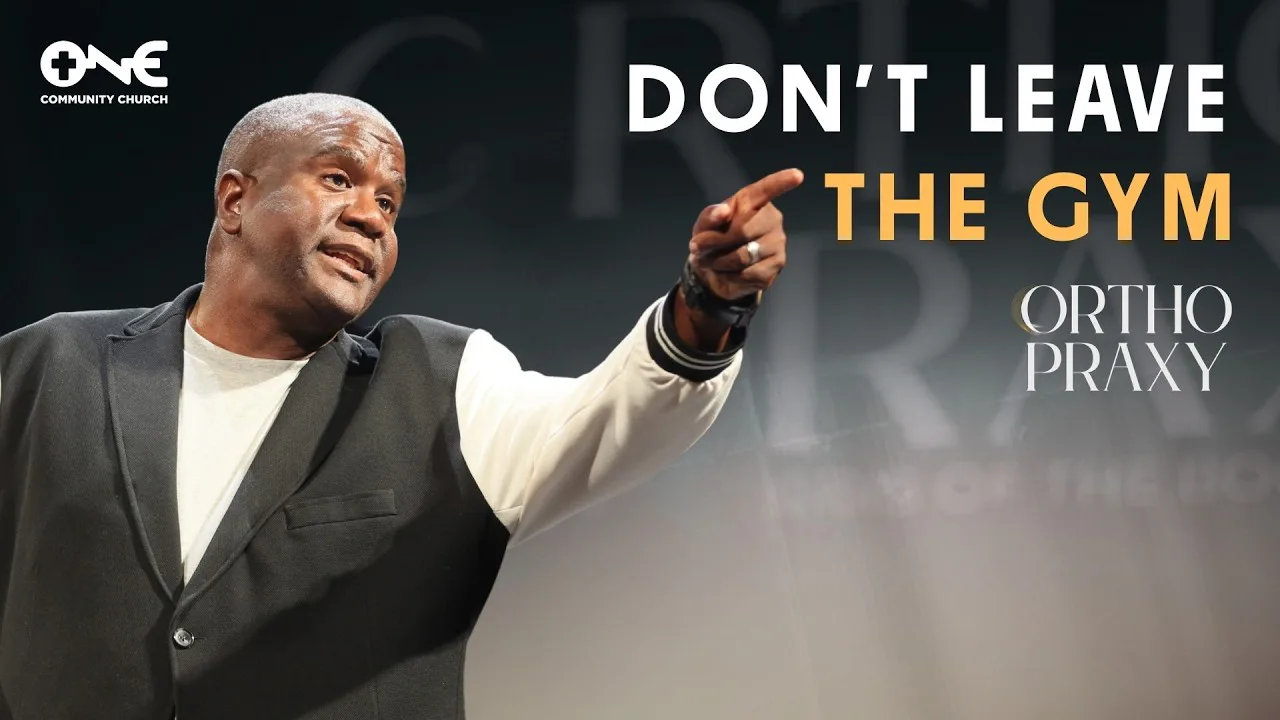
Don't Leave the Gym
Sermon notes from Dr. Conway Edwards at One Community Church on James, trials, endurance, and trusting God while he develops mature faith.
Close the gap
Father, lift these words off the pages and write them on our hearts so that the gap between what we believe and how we live closes, and we look more like Jesus.
Orthodoxy is right belief: correct doctrine and theology. Orthopraxy is right practice: how we live out our faith.
What you believe should match how you live. If there is a gap, close the gap.
Know the book of James
James was the first book One Community Church studied when the church began 18 years earlier. Returning to it verse by verse serves the same purpose: becoming a biblically literate church.
Chapter 1: Trials
When someone is going through a rough time, take them to James 1. The latter part of the chapter also addresses temptation.
2 Consider it pure joy, my brothers, when you encounter trials of many kinds,
3 because you know that the testing of your faith develops perseverance.
4 Allow perseverance to finish its work, so that you may be mature and complete, not lacking anything.
5 Now if any of you lacks wisdom, he should ask God, who gives generously to all without finding fault, and it will be given to him.
6 But he must ask in faith, without doubting, because he who doubts is like a wave of the sea, blown and tossed by the wind.
7 That man should not expect to receive anything from the Lord.
8 He is a double-minded man, unstable in all his ways.
9 The brother in humble circumstances should exult in his high position.
10 But the one who is rich should exult in his low position, because he will pass away like a flower of the field.
11 For the sun rises with scorching heat and withers the plant; its flower falls and its beauty is lost. So too, the rich man will fade away in the midst of his pursuits.
12 Blessed is the man who perseveres under trial, because when he has stood the test, he will receive the crown of life that God has promised to those who love Him.
13 When tempted, no one should say, “God is tempting me.” For God cannot be tempted by evil, nor does He tempt anyone.
14 But each one is tempted when by his own evil desires he is lured away and enticed.
15 Then after desire has conceived, it gives birth to sin; and sin, when it is full-grown, gives birth to death.
16 Do not be deceived, my beloved brothers.
17 Every good and perfect gift is from above, coming down from the Father of the heavenly lights, with whom there is no change or shifting shadow.
18 He chose to give us birth through the word of truth, that we would be a kind of firstfruits of His creation.
19 My beloved brothers, understand this: Everyone should be quick to listen, slow to speak, and slow to anger,
20 for man’s anger does not bring about the righteousness that God desires.
21 Therefore, get rid of all moral filth and every expression of evil, and humbly accept the word planted in you, which can save your souls.
22 Be doers of the word, and not hearers only. Otherwise, you are deceiving yourselves.
23 For anyone who hears the word but does not carry it out is like a man who looks at his face in a mirror,
24 and after observing himself goes away and immediately forgets what he looks like.
25 But the one who looks intently into the perfect law of freedom, and continues to do so—not being a forgetful hearer, but an effective doer—he will be blessed in what he does.
26 If anyone considers himself religious and yet does not bridle his tongue, he deceives his heart and his religion is worthless.
27 Pure and undefiled religion before our God and Father is this: to care for orphans and widows in their distress, and to keep oneself from being polluted by the world.
Chapter 2: Favoritism
When someone prefers one person over another, turn to James 2 and see what James has to say.
2 Suppose a man comes into your meeting wearing a gold ring and fine clothes, and a poor man in shabby clothes also comes in.
3 If you lavish attention on the man in fine clothes and say, “Here is a seat of honor,” but say to the poor man, “You must stand” or “Sit at my feet,”
4 have you not discriminated among yourselves and become judges with evil thoughts?
5 Listen, my beloved brothers: Has not God chosen the poor of this world to be rich in faith and to inherit the kingdom He promised those who love Him?
6 But you have dishonored the poor. Is it not the rich who oppress you and drag you into court?
7 Are they not the ones who blaspheme the noble name by which you have been called?
8 If you really fulfill the royal law stated in Scripture, “Love your neighbor as yourself,” you are doing well.
9 But if you show favoritism, you sin and are convicted by the law as transgressors.
10 Whoever keeps the whole law but stumbles at just one point is guilty of breaking all of it.
11 For He who said, “Do not commit adultery,” also said, “Do not murder.” If you do not commit adultery, but do commit murder, you have become a lawbreaker.
12 Speak and act as those who are going to be judged by the law that gives freedom.
13 For judgment without mercy will be shown to anyone who has not been merciful. Mercy triumphs over judgment.
14 What good is it, my brothers, if someone claims to have faith, but has no deeds? Can such faith save him?
15 Suppose a brother or sister is without clothes and daily food.
16 If one of you tells him, “Go in peace; stay warm and well fed,” but does not provide for his physical needs, what good is that?
17 So too, faith by itself, if it does not result in action, is dead.
18 But someone will say, “You have faith and I have deeds.” Show me your faith without deeds, and I will show you my faith by my deeds.
19 You believe that God is one. Good for you! Even the demons believe that—and shudder.
20 O foolish man, do you want evidence that faith without deeds is worthless?
21 Was not our father Abraham justified by what he did when he offered his son Isaac on the altar?
22 You see that his faith was working with his actions, and his faith was perfected by what he did.
23 And the Scripture was fulfilled that says, “Abraham believed God, and it was credited to him as righteousness,” and he was called a friend of God.
24 As you can see, a man is justified by his deeds and not by faith alone.
25 In the same way, was not even Rahab the prostitute justified by her actions when she welcomed the spies and sent them off on another route?
26 As the body without the spirit is dead, so faith without deeds is dead.
Chapter 3: Speech and the tongue
As Dr. Edwards puts it, we are shutting down the cursing ministry. James addresses what comes out of our mouths.
2 We all stumble in many ways. If anyone is never at fault in what he says, he is a perfect man, able to control his whole body.
3 When we put bits into the mouths of horses to make them obey us, we can guide the whole animal.
4 Consider ships as well. Although they are so large and are driven by strong winds, they are steered by a very small rudder wherever the pilot is inclined.
5 In the same way, the tongue is a small part of the body, but it boasts of great things. Consider how small a spark sets a great forest ablaze.
6 The tongue also is a fire, a world of wickedness among the parts of the body. It pollutes the whole person, sets the course of his life on fire, and is itself set on fire by hell.
7 All kinds of animals, birds, reptiles, and creatures of the sea are being tamed and have been tamed by man,
8 but no man can tame the tongue. It is a restless evil, full of deadly poison.
9 With the tongue we bless our Lord and Father, and with it we curse men, who have been made in God’s likeness.
10 Out of the same mouth come blessing and cursing. My brothers, this should not be!
11 Can both fresh water and salt water flow from the same spring?
12 My brothers, can a fig tree grow olives, or a grapevine bear figs? Neither can a salt spring produce fresh water.
13 Who is wise and understanding among you? Let him show it by his good conduct, by deeds done in the humility that comes from wisdom.
14 But if you harbor bitter jealousy and selfish ambition in your hearts, do not boast in it or deny the truth.
15 Such wisdom does not come from above, but is earthly, unspiritual, demonic.
16 For where jealousy and selfish ambition exist, there will be disorder and every evil practice.
17 But the wisdom from above is first of all pure, then peace-loving, gentle, accommodating, full of mercy and good fruit, impartial, and sincere.
18 Peacemakers who sow in peace reap the fruit of righteousness.
Chapter 4: Pride
James confronts pride.
2 You crave what you do not have; you kill and covet, but are unable to obtain it. You quarrel and fight. You do not have, because you do not ask.
3 And when you do ask, you do not receive, because you ask with wrong motives, that you may squander it on your pleasures.
4 You adulteresses! Do you not know that friendship with the world is hostility toward God? Therefore, whoever chooses to be a friend of the world renders himself an enemy of God.
5 Or do you think the Scripture says without reason that the Spirit He caused to dwell in us yearns with envy?
6 But He gives us more grace. This is why it says: “God opposes the proud, but gives grace to the humble.”
7 Submit yourselves, then, to God. Resist the devil, and he will flee from you.
8 Draw near to God, and He will draw near to you. Cleanse your hands, you sinners, and purify your hearts, you double-minded.
9 Grieve, mourn, and weep. Turn your laughter to mourning, and your joy to gloom.
10 Humble yourselves before the Lord, and He will exalt you.
11 Brothers, do not slander one another. Anyone who speaks against his brother or judges him speaks against the law and judges it. And if you judge the law, you are not a practitioner of the law, but a judge of it.
12 There is only one Lawgiver and Judge, the One who is able to save and destroy. But who are you to judge your neighbor?
13 Come now, you who say, “Today or tomorrow we will go to this or that city, spend a year there, carry on business, and make a profit.”
14 You do not even know what will happen tomorrow! What is your life? You are a mist that appears for a little while and then vanishes.
15 Instead, you ought to say, “If the Lord is willing, we will live and do this or that.”
16 As it is, you boast in your proud intentions. All such boasting is evil.
17 Anyone, then, who knows the right thing to do, yet fails to do it, is guilty of sin.
Chapter 5: Prayer
James teaches about prayer.
2 Your riches have rotted and moths have eaten your clothes.
3 Your gold and silver are corroded. Their corrosion will testify against you and consume your flesh like fire. You have hoarded treasure in the last days.
4 Look, the wages you withheld from the workmen who mowed your fields are crying out against you. The cries of the harvesters have reached the ears of the Lord of Hosts.
5 You have lived on earth in luxury and self-indulgence. You have fattened your hearts in the day of slaughter.
6 You have condemned and murdered the righteous, who did not resist you.
7 Be patient, then, brothers, until the Lord’s coming. See how the farmer awaits the precious fruit of the soil—how patient he is for the fall and spring rains.
8 You, too, be patient and strengthen your hearts, because the Lord’s coming is near.
9 Do not complain about one another, brothers, so that you will not be judged. Look, the Judge is standing at the door!
10 Brothers, as an example of patience in affliction, take the prophets who spoke in the name of the Lord.
11 See how blessed we consider those who have persevered. You have heard of Job’s perseverance and have seen the outcome from the Lord. The Lord is full of compassion and mercy.
12 Above all, my brothers, do not swear, not by heaven or earth or by any other oath. Simply let your “Yes” be yes, and your “No,” no, so that you will not fall under judgment.
13 Is any one of you suffering? He should pray. Is anyone cheerful? He should sing praises.
14 Is any one of you sick? He should call the elders of the church to pray over him and anoint him with oil in the name of the Lord.
15 And the prayer offered in faith will restore the one who is sick. The Lord will raise him up. If he has sinned, he will be forgiven.
16 Therefore confess your sins to each other and pray for each other so that you may be healed. The prayer of a righteous man has great power to prevail.
17 Elijah was a man just like us. He prayed earnestly that it would not rain, and it did not rain on the land for three and a half years.
18 Again he prayed, and the heavens gave rain, and the earth yielded its crops.
19 My brothers, if one of you should wander from the truth and someone should bring him back,
20 consider this: Whoever turns a sinner from the error of his way will save his soul from death and cover over a multitude of sins.
3 because you know that the testing of your faith develops perseverance.
4 Allow perseverance to finish its work, so that you may be mature and complete, not lacking anything.
5 Now if any of you lacks wisdom, he should ask God, who gives generously to all without finding fault, and it will be given to him.
Consider it all joy
Consider is an accounting word. James asks us to evaluate our trials, not merely through our own eyes, but through God's eyes.
Encounter carries the picture of being caught by surprise. The knock on the door, the unexpected phone call, the news you never imagined: those days come to everyone.
We need to learn how to respond before we reach the funeral, the hospital bed, or the financial crisis.
James does not ease us into it. He tells us to count it all joy because God is up to something.
God is preparing you
The testing of your faith is working toward greater trust and confidence in God.
There is another season coming, and God is preparing you for it. The weight room is not pointless. He is developing what you will need.
Dr. Edwards emphasizes that God is in control: what reaches you must first pass through him.
Don't leave the gym
Endurance means to hold up under. Something is over you, and you are called to remain under it without quitting.
Let endurance have its perfect result. Stay in the gym while God develops those muscles.
The goal is to be complete, lacking in nothing, prepared for the next season. Do not leave before the work is done.
The fork in the road
In his opening illustration, Dr. Edwards describes Billy Crystal responding to devastating losses by pulling away from conversations with God.
The questions are familiar: Why me? Why now? Why my family?
Every one of us will face a moment when we must decide: Will I walk away from God, or will I lean into God?
The central truth
God can use what we would never choose to produce a faith we could not develop any other way.
James writes to believers facing rejection, social exclusion, and poverty. His call to joy is addressed to people living through real hardship.
God is developing something in us, but our usual ways of responding can stand in the way.
What is your bent?
We all have patterns for responding to trials. Which one sounds like you?
- The avoider: Refuses to address the problem or pretends it is not there.
- The fixer: Tries to control every outcome.
- The worrier: Worries about what might happen before anything happens.
- The grinder: Works harder, determined to make it happen.
- The blamer: Makes everything someone else's fault.
- The martyr: Treats misery as evidence of devotion and wants others to feel sorry for them.
- The rebel: Uses pain to justify sinful choices.
God will confront those patterns so that we learn to trust him rather than hold on to control.
Question 1
What do you do when there is nothing you can do?
A frightening movie can be paused or turned off. Some situations in life cannot.
Dr. Edwards recalls being at his dying father's hospital bed in California, wanting more days or another year, but unable to change what was happening.
In that place, the response becomes: God, I have to trust you in the middle of this.
Reframe the storm
Adjust your perspective. Ask how the situation looks from God's point of view.
Joseph's pit, false accusation, and imprisonment could each have looked like a dead end. Yet God was taking him toward the palace.
It is not a dead end. It is a detour.
When God takes you into the gym, do not leave. He is developing something in you for the next season.
Question 2
What might God be doing in me through this?
Trials test the authenticity of our faith. They expose whether our confidence in God goes beyond what we say at church.
Dr. Edwards uses the picture of grapes being crushed to make wine. The crushing reveals what is inside and is part of the process.
The prayer becomes: God, do whatever you need to do to get me ready for the purposes you have for me in the next season.
What do I really believe?
Do I trust God when he does not do what I want?
Trials reveal the answer.
Joy is developed, not discovered. It is developed through the trial, not simply discovered when the trial is over.
Stay in the gym and learn what that looks like as God develops you.
What faith is not
- A way to manipulate God.
- A formula for getting God to do what you want.
- A tool for forcing a change in your circumstances.
- A deal in which you give God something so he will give you what you want.
Trusting, praying, or fasting is not a transaction that obligates God to deliver your preferred outcome.
What faith is
Faith is confidence that God is who he has revealed himself to be and that he will do what he has promised.
That means we need to know his promises. Otherwise, we may ask him for something he never promised and then treat the outcome as a failure of faith.
Faith is ultimately a response to God.
Respond to what God has promised
At Jericho, the people were not marching to make God give them the city. They were responding to what he had already promised.
Think of turning on a light. Flipping the switch does not build the power station or connect the house. The work has already been done.
Faith responds with confidence: God, I am trusting you to do what you said you would do.
Question 3
The question is not, How much faith do I need to get God to change this?
The question is:
Can I trust God even while this remains unchanged?
Can I trust him while I am still in the gym and the work is not finished?
Trials demonstrate and produce
Trials demonstrate whether our faith is genuine. They reveal whether we actually turn to God when things are not going well, or whether our praise is only for Sunday morning.
Trials produce perseverance. They do not merely show what is there. They develop the endurance we need.
The stresswood illustration
Dr. Edwards describes trees grown in a protected biosphere falling over because they had not developed the strengthening fibers he calls stresswood.
His point: resistance helps develop the ability to stand.
Be careful about trying to protect your children from every difficult experience. Be careful about avoiding every difficult situation yourself. Avoiding all resistance can leave us unprepared for the next season.
Trials exercise our faith muscles
Muscles grow stronger through exercise. But this is not always an exercise we choose. Sometimes the exercise chooses us.
Dr. Edwards names burpees and pull-ups as exercises he dislikes. Given the choice, he would choose something easier.
Yet the exercise we do not want may be the one we need. God is preparing us for the next season.
The thing you want removed
The thing you want removed may be the thing God is using.
Do not confuse the desire for relief with the completion of God's work in you.
Do not be double-minded
One moment we want to trust Jesus. The next, we want to take matters into our own hands.
Dr. Edwards illustrates that indecision with a rabbit darting back and forth in the road, unable to commit to a direction.
His warning is that the enemy exploits our divided trust, urging us to abandon God's way because we have waited long enough.
Do not remain caught between God's way and your own.
What mature faith looks like
Mature faith is not simply knowing Bible verses, attending church, saying the right things, or holding positive beliefs.
It comes through facing a trial and experiencing God's faithfulness in it.
- Trials come.
- Faith is tested.
- Perseverance develops.
- Maturity grows.
- Jesus becomes our treasure.
God is after the place we give him. Things we treasure more than Jesus must not remain in the number one slot.
Our prayer posture
God, use this until you choose to remove it.
Whatever it is, and however painful it is: use this until you choose to remove it.
- The goal is maturity, not merely relief.
- The process is producing something in me.
- Grown-up faith comes through experience.
Shake it off and stand on it
In the closing illustration, a farmer throws a mule into a hole and begins covering it with dirt. Each time dirt lands on its back, the mule shakes it off and steps up onto it.
Eventually, the mule walks out.
What was meant to bury it became something it could stand on.
When the next trial comes, Dr. Edwards urges: shake it off, then stand on the dirt.
Thomas Dorsey's grief
Dr. Edwards closes with the story of Thomas Dorsey losing his wife in childbirth and then losing his son.
Dorsey wanted nothing more to do with God. He was doing God's work, yet he was facing devastating loss.
A friend came alongside him and encouraged him to put his pain into a song. From that experience came Precious Lord, Take My Hand.
His pain became an expression of dependence on God.
Lean into God
Dr. Edwards contrasts the opening illustration with Dorsey's story, emphasizing the difference a friend can make in helping someone interpret pain and regain confidence in God.
We do not know what is coming. The call is to hold up under it, persevere, and lean into God rather than run from him.
When the trial makes no sense, ask him to remind you of his love.
Don't leave the gym.
Closing prayer
Father, lead your people. We do not know what is coming outside these doors, but you know today, tomorrow, and the years ahead.
By the power of the Holy Spirit, we will trust you and your way. Grow our faith. Increase our confidence in you.
When the knock comes, prepare us to enter the gym with the posture Jesus showed in Gethsemane: not my will, but yours.
Jesus endured the pain and shame with joy set before him. Thank you for the redemption you accomplished through him.
Help us be a light to a dark world. In Jesus' name, amen.