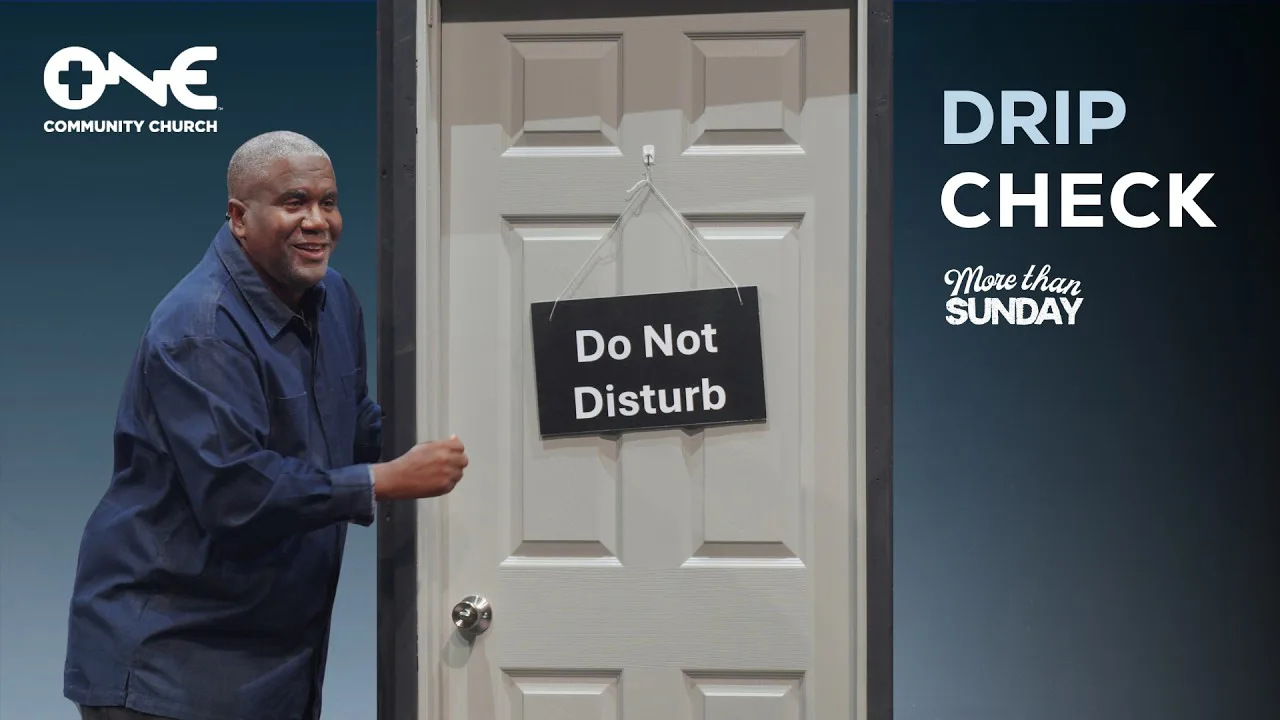
Drip Check
Sermon notes from Dr. Conway Edwards at One Community Church, concluding More Than Sunday with a call to recognize spiritual drift, confront self-deception, and return to intimacy with Jesus.
More Than Sunday
We recognized that we had drifted as a church. This series asks: God, what did you intend this thing called the church to be?
Our assignment is to make the adjustments that bring us back to what God has called us to be.
Healthy big means doing small great
If we are going to be healthy big, we must do small great.
We hear the Word, discuss it in smaller groups, and apply it to our lives so that we look more like Jesus. Fellowship includes holding one another accountable to living out the Word of God.
God did not give us his Word simply so we could get something from him. He gave it so we could mature to look like him.
Resist the pull toward insiders
Every church has a gravitational pull toward insiders: my preferences, my needs, my music, and what I want.
When we make church about ourselves, we turn our backs on outsiders. We must resist that pull.
2 So the Pharisees and scribes began to grumble: “This man welcomes sinners and eats with them.”
3 Then Jesus told them this parable:
4 “What man among you, if he has a hundred sheep and loses one of them, does not leave the ninety-nine in the pasture and go after the one that is lost, until he finds it?
5 And when he finds it, he joyfully puts it on his shoulders,
6 comes home, and calls together his friends and neighbors to tell them, ‘Rejoice with me, for I have found my lost sheep!’
7 In the same way, I tell you that there will be more joy in heaven over one sinner who repents than over ninety-nine righteous ones who do not need to repent.
8 Or what woman who has ten silver coins and loses one of them does not light a lamp, sweep her house, and search carefully until she finds it?
9 And when she finds it, she calls together her friends and neighbors to say, ‘Rejoice with me, for I have found my lost coin.’
10 In the same way, I tell you, there is joy in the presence of God’s angels over one sinner who repents.”
11 Then Jesus said, “There was a man who had two sons.
12 The younger son said to him, ‘Father, give me my share of the estate.’ So he divided his property between them.
13 After a few days, the younger son got everything together and journeyed to a distant country, where he squandered his wealth in wild living.
14 After he had spent all he had, a severe famine swept through that country, and he began to be in need.
15 So he went and hired himself out to a citizen of that country, who sent him into his fields to feed the pigs.
16 He longed to fill his belly with the pods the pigs were eating, but no one would give him a thing.
17 Finally he came to his senses and said, ‘How many of my father’s hired servants have plenty of food? But here I am, starving to death!
18 I will get up and go back to my father and say to him, “Father, I have sinned against heaven and against you.
19 I am no longer worthy to be called your son. Make me like one of your hired servants.”’
20 So he got up and went to his father. But while he was still in the distance, his father saw him and was filled with compassion. He ran to his son, embraced him, and kissed him.
21 The son declared, ‘Father, I have sinned against heaven and against you. I am no longer worthy to be called your son. ’
22 But the father said to his servants, ‘Quick! Bring the best robe and put it on him. Put a ring on his finger and sandals on his feet.
23 Bring the fattened calf and kill it. Let us feast and celebrate.
24 For this son of mine was dead and is alive again! He was lost and is found!’ So they began to celebrate.
25 Meanwhile the older son was in the field, and as he approached the house, he heard music and dancing.
26 So he called one of the servants and asked what was going on.
27 ‘Your brother has returned,’ he said, ‘and your father has killed the fattened calf, because he has him back safe and sound.’
28 The older son became angry and refused to go in. So his father came out and pleaded with him.
29 But he answered his father, ‘Look, all these years I have served you and never disobeyed a commandment of yours. Yet you never gave me even a young goat so I could celebrate with my friends.
30 But when this son of yours returns from squandering your wealth with prostitutes, you kill the fattened calf for him!’
31 ‘Son, you are always with me,’ the father said, ‘and all that is mine is yours.
32 But it was fitting to celebrate and be glad, because this brother of yours was dead and is alive again; he was lost and is found.’”
Jesus treasures lost people
Jesus will leave the ninety-nine to find the one. That includes people who do not think, act, believe, vote, or look like us.
We cannot make the church partisan and tell the other side they are not welcome. The gospel is more important than who gets into power.
We do not get to create barriers to people Jesus loves.
Apply what you already know
Be careful when you say, “I want to go deeper.” What we need to say is, “I want to apply what I already know.”
Peter had to get out of the boat. Abraham had to act on what he knew about God.
The question is not how many notes, podcasts, or videos we have collected. Are we applying the Word so that we look more like Jesus?
You can adjust without noticing
Walk into a cold room and, after a while, you may stop noticing the temperature. The temperature did not change. You adjusted.
The same thing can happen in church. You used to serve eagerly. You used to weep when someone came to Christ. You used to celebrate baptisms. Now you want everyone to hurry up.
Your heart can grow cold toward God without your realizing it.
2 who testifies to everything he saw. This is the word of God and the testimony of Jesus Christ.
3 Blessed is the one who reads aloud the words of this prophecy, and blessed are those who hear and obey what is written in it, because the time is near.
4 John, To the seven churches in the province of Asia: Grace and peace to you from Him who is and was and is to come, and from the seven Spirits before His throne,
5 and from Jesus Christ, the faithful witness, the firstborn from the dead, and the ruler of the kings of the earth. To Him who loves us and has released us from our sins by His blood,
6 who has made us to be a kingdom, priests to His God and Father—to Him be the glory and power forever and ever! Amen.
7 Behold, He is coming with the clouds, and every eye will see Him—even those who pierced Him. And all the tribes of the earth will mourn because of Him. So shall it be! Amen.
8 “I am the Alpha and the Omega, ” says the Lord God, who is and was and is to come—the Almighty.
9 I, John, your brother and partner in the tribulation and kingdom and perseverance that are in Jesus, was on the island of Patmos because of the word of God and my testimony about Jesus.
10 On the Lord’s day I was in the Spirit, and I heard behind me a loud voice like a trumpet,
11 saying, “Write on a scroll what you see and send it to the seven churches: to Ephesus, Smyrna, Pergamum, Thyatira, Sardis, Philadelphia, and Laodicea.”
12 Then I turned to see the voice that was speaking with me. And having turned, I saw seven golden lampstands,
13 and among the lampstands was One like the Son of Man, dressed in a long robe, with a golden sash around His chest.
14 The hair of His head was white like wool, as white as snow, and His eyes were like a blazing fire.
15 His feet were like polished bronze refined in a furnace, and His voice was like the roar of many waters.
16 He held in His right hand seven stars, and a sharp double-edged sword came from His mouth. His face was like the sun shining at its brightest.
17 When I saw Him, I fell at His feet like a dead man. But He placed His right hand on me and said, “Do not be afraid. I am the First and the Last,
18 the Living One. I was dead, and behold, now I am alive forever and ever! And I hold the keys of Death and of Hades.
19 Therefore write down the things you have seen, and the things that are, and the things that will happen after this.
20 This is the mystery of the seven stars you saw in My right hand and of the seven golden lampstands: The seven stars are the angels of the seven churches, and the seven lampstands are the seven churches.
Jesus evaluates his church
Jesus gives John letters for seven churches. He addresses their condition and calls them to make the necessary corrections.
The warning for us is that a church can drift so far that its people think they are close to God while Jesus is outside, knocking.
2 I know your deeds, your labor, and your perseverance. I know that you cannot tolerate those who are evil, and you have tested and exposed as liars those who falsely claim to be apostles.
3 Without growing weary, you have persevered and endured many things for the sake of My name.
4 But I have this against you: You have abandoned your first love.
5 Therefore, keep in mind how far you have fallen. Repent and perform the deeds you did at first. But if you do not repent, I will come to you and remove your lampstand from its place.
6 But you have this to your credit: You hate the works of the Nicolaitans, which I also hate.
7 He who has an ear, let him hear what the Spirit says to the churches. To the one who overcomes, I will grant the right to eat from the tree of life in the Paradise of God.
8 To the angel of the church in Smyrna write: These are the words of the First and the Last, who died and returned to life.
9 I know your affliction and your poverty—though you are rich! And I am aware of the slander of those who falsely claim to be Jews, but are in fact a synagogue of Satan.
10 Do not fear what you are about to suffer. Look, the devil is about to throw some of you into prison to test you, and you will suffer tribulation for ten days. Be faithful even unto death, and I will give you the crown of life.
11 He who has an ear, let him hear what the Spirit says to the churches. The one who overcomes will not be harmed by the second death.
12 To the angel of the church in Pergamum write: These are the words of the One who holds the sharp, double-edged sword.
13 I know where you live, where the throne of Satan sits. Yet you have held fast to My name and have not denied your faith in Me, even in the day when My faithful witness Antipas was killed among you, where Satan dwells.
14 But I have a few things against you, because some of you hold to the teaching of Balaam, who taught Balak to place a stumbling block before the Israelites so they would eat food sacrificed to idols and commit sexual immorality.
15 In the same way, some of you also hold to the teaching of the Nicolaitans.
16 Therefore repent! Otherwise I will come to you shortly and wage war against them with the sword of My mouth.
17 He who has an ear, let him hear what the Spirit says to the churches. To the one who overcomes, I will give the hidden manna. I will also give him a white stone inscribed with a new name, known only to the one who receives it.
18 To the angel of the church in Thyatira write: These are the words of the Son of God, whose eyes are like a blazing fire and whose feet are like polished bronze.
19 I know your deeds—your love, your faith, your service, your perseverance—and your latter deeds are greater than your first.
20 But I have this against you: You tolerate that woman Jezebel, who calls herself a prophetess. By her teaching she misleads My servants to be sexually immoral and to eat food sacrificed to idols.
21 Even though I have given her time to repent of her immorality, she is unwilling.
22 Behold, I will cast her onto a bed of sickness, and those who commit adultery with her will suffer great tribulation unless they repent of her deeds.
23 Then I will strike her children dead, and all the churches will know that I am the One who searches minds and hearts, and I will repay each of you according to your deeds.
24 But I say to the rest of you in Thyatira, who do not hold to her teaching and have not learned the so-called deep things of Satan: I will place no further burden upon you.
25 Nevertheless, hold fast to what you have until I come.
26 And to the one who overcomes and continues in My work until the end, I will give authority over the nations.
27 He will rule them with an iron scepter and shatter them like pottery —just as I have received authority from My Father.
28 And I will give him the morning star.
29 He who has an ear, let him hear what the Spirit says to the churches.
2 Wake up and strengthen what remains, which was about to die; for I have found your deeds incomplete in the sight of My God.
3 Remember, then, what you have received and heard. Keep it and repent. If you do not wake up, I will come like a thief, and you will not know the hour when I will come upon you.
4 But you do have a few people in Sardis who have not soiled their garments, and because they are worthy, they will walk with Me in white.
5 Like them, he who overcomes will be dressed in white. And I will never blot out his name from the Book of Life, but I will confess his name before My Father and His angels.
6 He who has an ear, let him hear what the Spirit says to the churches.
7 To the angel of the church in Philadelphia write: These are the words of the One who is holy and true, who holds the key of David. What He opens no one can shut, and what He shuts no one can open.
8 I know your deeds. See, I have placed before you an open door, which no one can shut. For you have only a little strength, yet you have kept My word and have not denied My name.
9 Look at those who belong to the synagogue of Satan, who claim to be Jews but are liars instead. I will make them come and bow down at your feet, and they will know that I love you.
10 Because you have kept My command to persevere, I will also keep you from the hour of testing that is about to come upon the whole world, to test those who dwell on the earth.
11 I am coming soon. Hold fast to what you have, so that no one will take your crown.
12 The one who overcomes I will make a pillar in the temple of My God, and he will never again leave it. Upon him I will write the name of My God, and the name of the city of My God (the new Jerusalem that comes down out of heaven from My God), and My new name.
13 He who has an ear, let him hear what the Spirit says to the churches.
14 To the angel of the church in Laodicea write: These are the words of the Amen, the faithful and true Witness, the Originator of God’s creation.
15 I know your deeds; you are neither cold nor hot. How I wish you were one or the other!
16 So because you are lukewarm—neither hot nor cold—I am about to vomit you out of My mouth!
17 You say, ‘I am rich; I have grown wealthy and need nothing.’ But you do not realize that you are wretched, pitiful, poor, blind, and naked.
18 I counsel you to buy from Me gold refined by fire so that you may become rich, white garments so that you may be clothed and your shameful nakedness not exposed, and salve to anoint your eyes so that you may see.
19 Those I love, I rebuke and discipline. Therefore be earnest and repent.
20 Behold, I stand at the door and knock. If anyone hears My voice and opens the door, I will come in and dine with him, and he with Me.
21 To the one who overcomes, I will grant the right to sit with Me on My throne, just as I overcame and sat down with My Father on His throne.
22 He who has an ear, let him hear what the Spirit says to the churches.”
The seven churches
- Ephesus: The loveless church that had lost its first love.
- Smyrna: The persecuted church, called to suffer well.
- Pergamum: The compromising church, challenged over doctrinal compromise.
- Thyatira: The corrupt church, challenged over sexual immorality and compromise.
- Sardis: The dead church, unaware of its spiritual deadness.
- Philadelphia: The faithful church, whose faithfulness would be challenged.
- Laodicea: The lukewarm church, neither hot nor cold.
Do not make the little thing the big thing
A spiritual gift must not become the centerpiece of the gospel of Jesus Christ.
Speaking in tongues, prophecy, or any other gift is not the whole purpose of the local church. When we make our gift the biggest thing, we miss the point.
“I know your deeds”
Jesus is always evaluating us. He sees how we treat one another in small groups and when we come to church.
He sees whether our behavior matches what we say we believe.
We cannot keep one foot in church and one foot in a life that contradicts the Word of God, then treat that contradiction as normal.
Looking good is not the same as being alive
A mannequin can wear the finest clothes and still have nothing on the inside.
We can spend more time getting dressed for church than praying, reading Scripture, or kneeling before God to say, “Have your way as I worship you.”
The danger is allowing the world’s definition of success to define spiritual success.
Wealth must not control you
Dr. Edwards distinguished property, equity, and business from spending everything on jewelry, cars, and clothes.
Wealth itself is not the problem. Abraham, David, and Solomon had wealth. The problem is when wealth controls us.
It is extremely hard to be wealthy, mature, and godly when our dependence on money competes with our dependence on God.
What comes first?
The rich young ruler would not give up his wealth to follow Jesus. Zacchaeus put Jesus above his prosperity.
You may have passion for making money and doing business. But do you have the same, and greater, passion for the things of God?
You cannot serve two masters. You have to choose.
Laodicea’s water
Nearby Colossae had refreshing cold water. Hierapolis had hot springs. Laodicea depended on water carried through aqueducts.
By the time it arrived, the water was lukewarm and mineral-laden, making people nauseated.
Jesus used what they experienced every day to expose their spiritual condition: neither hot nor cold.
Inside out, not outside in
We try to take care of the body and assume the soul and spirit will follow. We dress for success and expect the inside to be refreshed.
But intimacy with God begins at the spirit level. As the spirit is filled, it affects the soul, and the soul affects the body.
The world says outside in. The Word says inside out.
Jesus is not an accessory
Do I merely have Jesus somewhere in my life, or have I recognized him as the treasure worth reorganizing my entire life around?
Think of a campfire: everything is arranged around it. Jesus is to be at the center, with our family, business, and everything else arranged around him.
Following Jesus is less about what you are losing and more about what you have found.
Self-sufficiency became spiritual deception
Laodicea was known for three industries:
- Finance: Wealth sufficient to rebuild after an earthquake without Rome’s assistance.
- Fashion: Distinctive black, shiny wool.
- Pharmaceuticals: Treatments associated with eye care.
Their civic self-sufficiency became a picture of their spiritual self-sufficiency.
The danger of self-deception
Self-deception can be more dangerous than open rebellion: you believe you are right with God when you are actually far from him.
Religious activity is not the same as knowing Christ. You can participate in Christian culture without submitting to Jesus as Lord.
You can become so convinced that you love God that you are no longer teachable.
What does lukewarmness look like?
It looks like refusing to decide, trying to remain in both worlds.
Dr. Edwards described two ways of understanding the warning:
- Ineffectiveness: Neither hot nor cold.
- Complacency: Content to remain as you are.
Jesus calls the church to confront its condition rather than continue deceiving itself.
Open the door
Jesus is knocking. He wants intimacy with his people. He wants to dine with them.
Our response cannot remain, “Do not disturb.” We need to open the door and address the sins that self-deception has hidden.
The sermon closes with confession, not concern about somebody else’s condition.
Name what needs confession
Among the sins named in the sermon:
- Gossip and slander
- Dishonesty
- Unforgiveness
- Mistreating a spouse or loved ones
- Covetousness, comparison, and jealousy
- Lack of prayer
- Neglecting Scripture
- Serving publicly while living sinfully privately
- Poor leadership
“God, here is the one I am struggling with. Here is how wealth has deceived me.”
Leaders go first
Pastors, staff, deacons, and small group leaders were asked to stand first and intentionally open the door to intimacy with God.
Dr. Edwards named his own struggle with comparison: asking why God had not given him more and why the weight was so heavy.
The correction: stop looking at somebody else’s race. Enjoy what God has given you and live the race he has called you to live.
A prayer of surrender
God, please enter. We are broken. We are sorry. Forgive us.
We want to be used by you in our businesses, homes, schools, and the marketplace. Wash us clean so that we can be usable.
Thank you for exposing where self-deception has taken over. Forgive us for adopting the world’s definition of success, for compromising, and for being ineffective.
We return to our first love and make it all about you. We surrender all for your glory. If you can use anything, Lord, here we are. Use us.
In Jesus’ name, amen.