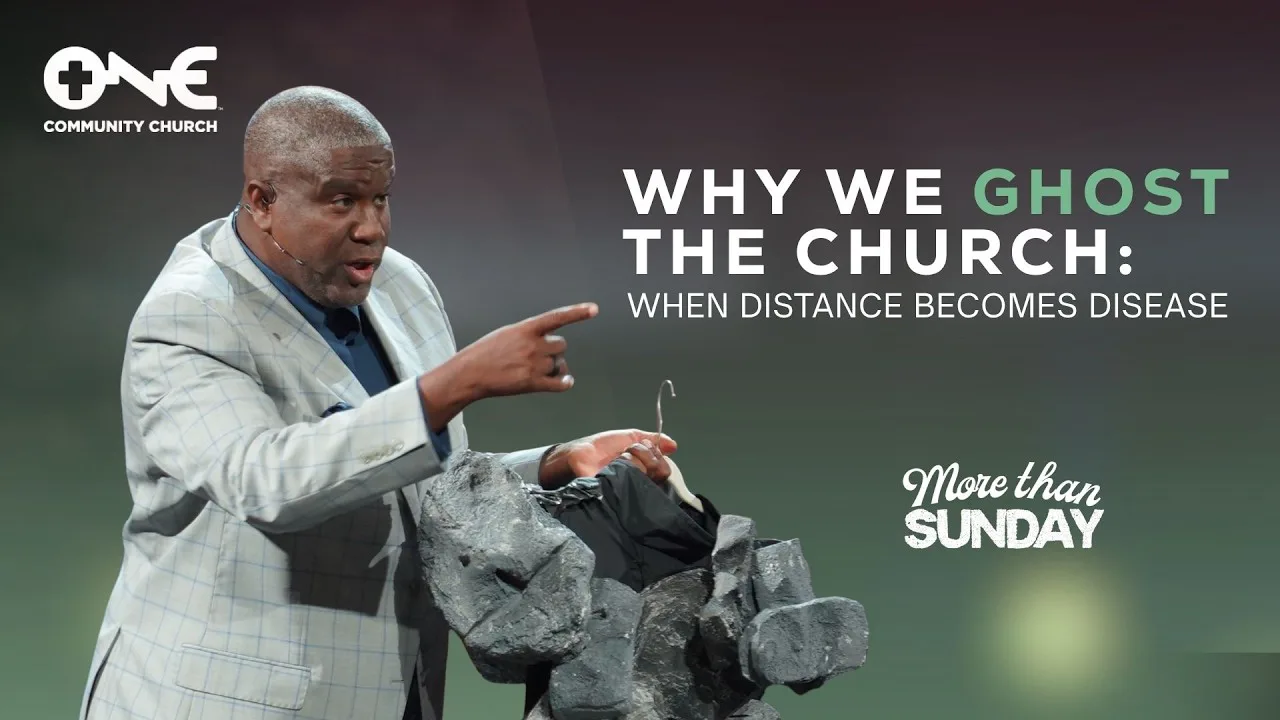
Why We Ghost the Church: When Distance Becomes Disease
Sermon notes from Dr. Conway Edwards at One Community Church on closing the gap between belief and behavior, preserving unity, and addressing unresolved conflict.
Raise Our View of the Church
So many people have a low view of the church. The opening prayer asks God to raise our view of his bride.
When we lower our view of church, we blur the only picture the world has of the invisible God. The church is the visible representation of the invisible Jesus Christ.
2 with all humility and gentleness, with patience, bearing with one another in love,
3 and with diligence to preserve the unity of the Spirit through the bond of peace.
Walk Worthy of Your Calling
Paul connects what God has done for us with how we are called to live. His appeal is not simply to try harder or behave better. It is to live out the transformation Jesus has already begun within us.
Ephesians 1-3
First, What Jesus Has Done
The first three chapters lay the foundation: Jesus has adopted us into his family and given us an inheritance.
Dr. Edwards contrasts the one imperative in these chapters with their many statements about what God has done. Our obedience begins with receiving and understanding that work.
Ephesians 4-6
Then, How We Live
The last three chapters contain 40 imperatives: instructions for living in light of what God has done.
If we pursue these commands without the gospel foundation, we turn toward legalism, moralism, and comparing ourselves with others. The motivation for obedience is gospel transformation, not proving that we are good.
Paul's Life Matches His Belief
Paul identifies himself as a prisoner of the Lord. He believes this message so deeply that he has been imprisoned for living it.
Loving someone who hates you cannot be sustained by moral effort alone. It requires Jesus to transform you from the inside out.
Close the Gap
Dr. Edwards describes a widening gap between what Christians say they believe and how they behave. He cites a figure of 24% identifying as practicing Christians, defined by Christian identity, regular church attendance, and belief in God.
Faith should inform our decisions, relationships, finances, worldview, and priorities. Saying we believe while refusing to live accordingly makes us non-practicing Christians.
The gap between belief and behavior should be closing, not widening.
That Is Who I Used to Be
Using two tents, Dr. Edwards illustrates the difference between the old life and the new life God has given us.
We cannot keep trying to fit our new identity in Jesus over our former way of living. When we want to lash out, harbor malice, or abandon relationships, we must remember: that is who we used to be.
Now we can acknowledge hurt, have a conversation, and ask forgiveness instead of returning to old patterns.
2 And by the seventh day God had finished the work He had been doing; so on that day He rested from all His work.
3 Then God blessed the seventh day and sanctified it, because on that day He rested from all the work of creation that He had accomplished.
4 This is the account of the heavens and the earth when they were created, in the day that the LORD God made them.
5 Now no shrub of the field had yet appeared on the earth, nor had any plant of the field sprouted; for the LORD God had not yet sent rain upon the earth, and there was no man to cultivate the ground.
6 But springs welled up from the earth and watered the whole surface of the ground.
7 Then the LORD God formed man from the dust of the ground and breathed the breath of life into his nostrils, and the man became a living being.
8 And the LORD God planted a garden in Eden, in the east, where He placed the man He had formed.
9 Out of the ground the LORD God gave growth to every tree that is pleasing to the eye and good for food. And in the middle of the garden were the tree of life and the tree of the knowledge of good and evil.
10 Now a river flowed out of Eden to water the garden, and from there it branched into four headwaters:
11 The name of the first river is Pishon; it winds through the whole land of Havilah, where there is gold.
12 And the gold of that land is pure, and bdellium and onyx are found there.
13 The name of the second river is Gihon; it winds through the whole land of Cush.
14 The name of the third river is Hiddekel; it runs along the east side of Assyria. And the fourth river is the Euphrates.
15 Then the LORD God took the man and placed him in the Garden of Eden to cultivate and keep it.
16 And the LORD God commanded him, “You may eat freely from every tree of the garden,
17 but you must not eat from the tree of the knowledge of good and evil; for in the day that you eat of it, you will surely die.”
18 The LORD God also said, “It is not good for the man to be alone. I will make for him a suitable helper.”
19 And out of the ground the LORD God formed every beast of the field and every bird of the air, and He brought them to the man to see what he would name each one. And whatever the man called each living creature, that was its name.
20 The man gave names to all the livestock, to the birds of the air, and to every beast of the field. But for Adam no suitable helper was found.
21 So the LORD God caused the man to fall into a deep sleep, and while he slept, He took one of the man’s ribs and closed up the area with flesh.
22 And from the rib that the LORD God had taken from the man, He made a woman and brought her to him.
23 And the man said: “This is now bone of my bones and flesh of my flesh; she shall be called ‘woman,’ for out of man she was taken.”
24 For this reason a man will leave his father and mother and be united to his wife, and they will become one flesh.
25 And the man and his wife were both naked, and they were not ashamed.
2 Suddenly a sound like a mighty rushing wind came from heaven and filled the whole house where they were sitting.
3 They saw tongues like flames of fire that separated and came to rest on each of them.
4 And they were all filled with the Holy Spirit and began to speak in other tongues as the Spirit enabled them.
5 Now there were dwelling in Jerusalem God-fearing Jews from every nation under heaven.
6 And when this sound rang out, a crowd came together in bewilderment, because each one heard them speaking his own language.
7 Astounded and amazed, they asked, “Are not all these men who are speaking Galileans?
8 How is it then that each of us hears them in his own native language?
9 Parthians, Medes, and Elamites; residents of Mesopotamia, Judea and Cappadocia, Pontus and Asia,
10 Phrygia and Pamphylia, Egypt and the parts of Libya near Cyrene; visitors from Rome,
11 both Jews and converts to Judaism; Cretans and Arabs—we hear them declaring the wonders of God in our own tongues!”
12 Astounded and perplexed, they asked one another, “What does this mean?”
13 But others mocked them and said, “They are drunk on new wine!”
14 Then Peter stood up with the Eleven, lifted up his voice, and addressed the crowd: “Men of Judea and all who dwell in Jerusalem, let this be known to you, and listen carefully to my words.
15 These men are not drunk, as you suppose. It is only the third hour of the day!
16 No, this is what was spoken by the prophet Joel:
17 ‘In the last days, God says, I will pour out My Spirit on all people. Your sons and daughters will prophesy, your young men will see visions, your old men will dream dreams.
18 Even on My menservants and maidservants I will pour out My Spirit in those days, and they will prophesy.
19 I will show wonders in the heavens above and signs on the earth below, blood and fire and billows of smoke.
20 The sun will be turned to darkness, and the moon to blood, before the coming of the great and glorious Day of the Lord.
21 And everyone who calls on the name of the Lord will be saved.’
22 Men of Israel, listen to this message: Jesus of Nazareth was a man certified by God to you by miracles, wonders, and signs, which God did among you through Him, as you yourselves know.
23 He was delivered up by God’s set plan and foreknowledge, and you, by the hands of the lawless, put Him to death by nailing Him to the cross.
24 But God raised Him from the dead, releasing Him from the agony of death, because it was impossible for Him to be held in its clutches.
25 David says about Him: ‘I saw the Lord always before me; because He is at my right hand, I will not be shaken.
26 Therefore my heart is glad and my tongue rejoices; my body also will dwell in hope,
27 because You will not abandon my soul to Hades, nor will You let Your Holy One see decay.
28 You have made known to me the paths of life; You will fill me with joy in Your presence.’
29 Brothers, I can tell you with confidence that the patriarch David died and was buried, and his tomb is with us to this day.
30 But he was a prophet and knew that God had promised him on oath that He would place one of his descendants on his throne.
31 Foreseeing this, David spoke about the resurrection of the Christ, that He was not abandoned to Hades, nor did His body see decay.
32 God has raised this Jesus to life, to which we are all witnesses.
33 Exalted, then, to the right hand of God, He has received from the Father the promised Holy Spirit and has poured out what you now see and hear.
34 For David did not ascend into heaven, but he himself says: ‘The Lord said to my Lord, “Sit at My right hand
35 until I make Your enemies a footstool for Your feet.”’
36 Therefore let all Israel know with certainty that God has made this Jesus, whom you crucified, both Lord and Christ!”
37 When the people heard this, they were cut to the heart and asked Peter and the other apostles, “Brothers, what shall we do?”
38 Peter replied, “Repent and be baptized, every one of you, in the name of Jesus Christ for the forgiveness of your sins, and you will receive the gift of the Holy Spirit.
39 This promise belongs to you and your children and to all who are far off—to all whom the Lord our God will call to Himself.”
40 With many other words he testified, and he urged them, “Be saved from this corrupt generation.”
41 Those who embraced his message were baptized, and about three thousand were added to the believers that day.
42 They devoted themselves to the apostles’ teaching and to the fellowship, to the breaking of bread and to prayer.
43 A sense of awe came over everyone, and the apostles performed many wonders and signs.
44 All the believers were together and had everything in common.
45 Selling their possessions and goods, they shared with anyone who was in need.
46 With one accord they continued to meet daily in the temple courts and to break bread from house to house, sharing their meals with gladness and sincerity of heart,
47 praising God and enjoying the favor of all the people. And the Lord added to their number daily those who were being saved.
No Isolated Believers
Recalling Genesis 2, Dr. Edwards notes that it was not good for Adam to be alone. In Acts 2, he points to believers devoted to teaching and fellowship.
The church should be:
- Hungry: devoted to the teaching of God's Word.
- Loving: committed to fellowship and accountability.
- Generous: willing to share.
- Evangelistic: reaching others.
Community helps us apply what we hear. We need people who love us enough to call us back when our behavior does not match our beliefs.
Fight for Each Other
No one should come into the church and leave without anyone speaking to them. Greet people. Ask how they are doing and whether there is anything you can pray about.
We are a body of believers. Fellowship is more than being in the same room; it includes helping one another live what we say we believe.
Why We Avoid Fellowship
- Past hurt and bad experiences.
- Fear of exposure.
- Consumer Christianity.
- Unresolved conflict.
- Busyness and isolation.
We often keep fighting for other things that matter to us but give up quickly when community becomes difficult. Studying Scripture and being held accountable to apply it are part of closing the gap.
The Weight of the Call
Dr. Edwards explains “worthy” in terms of weight. God's calling is too weighty for us to treat relationships casually or write people off over trivial decisions.
He points to Esau giving up his birthright for stew as an illustration of trading something weighty for something small.
Our relationships matter because the world is meant to see what Jesus looks like through his body.
First: Humility
Humility concerns how we see ourselves.
Rein in the desire to brag, show off, or become haughty. See yourself in light of who God is and what he has done for you.
Order matters: you cannot be gentle if you are not humble, and you cannot be patient if you are not gentle.
Second: Gentleness
Gentleness concerns how we respond when we are hurt.
It is the ability to suffer injury without becoming angry and seeking revenge. We do not have to respond to people in the same way they responded to us.
Remember how gently God has treated you, and how gently he continues to treat you.
Third: Patience
Patience concerns how we respond to other people's failures, quirks, and irritating habits.
Consider how patient God has been with you, even this morning. We are called to extend to others what he gives us every day.
Humility, gentleness, and patience flow from being loved by God, not merely from gritting our teeth.
Preserve What the Spirit Has Created
We do not create the Spirit's unity. We preserve it.
A museum caretaker does not paint the masterpiece. The caretaker protects it. In the same way, believers are responsible for guarding the unity already given by the Spirit.
Pride, retaliation, and impatience damage that unity. Humility, gentleness, and patience help preserve it in the bond of peace.
We Belong to One Another
Put away lying and speak truth. We are members of one another.
Using a model of the body, Dr. Edwards illustrates that when one part hurts, the whole body is affected. Cutting someone off disfigures the body rather than repairing it.
Have the conversation. When conflict remains unresolved, involve others who can speak into it, including church leadership. Accountability and correction belong within the church's protective care.
Anger Is Not Permission to Sin
Paul assumes that friction and anger will occur when people come together. The question is what we do with that anger.
- Humility: remember your own failures before God.
- Gentleness: give the grace God has given you.
- Patience: allow others the time God has allowed you.
Address conflict as quickly as you can rather than letting anger remain unresolved.
Stop Carrying the Rocks
Every conversation we refuse to have becomes another rock we carry. Each rock represents an unresolved issue with someone.
Eventually, a small encounter can trigger an explosion under the weight of everything we have accumulated.
Some explosions are not about what happened today. They are the weight of everything we refused to address yesterday.
Unresolved anger gives the devil an opportunity to damage the church.
Look for the Way Through
Stop looking only for a way out. Ask what God is working to remove from you.
Be careful when your valley becomes a villain story in which everyone else is always the problem.
Mature believers take ownership of their lives. Here is the blame test:
Can I describe what is wrong without making someone else the villain?
What Is God Working on in You?
- Insecurity.
- Control.
- Conflict avoidance.
- Blame.
- Fear.
- Emotional immaturity.
- People pleasing.
- Impatience.
Do not simply agree with the sermon and return home with the same malice, drama, and hatred. Identify what needs to change in you.
Courageous Conversations Create Trust
Rebuilding trust begins with talking to the person.
Dr. Edwards offers this opening: “I had an understanding of something that might not be what you intended, but this is how I perceived it.”
Take up each rock and deal with it. If you cannot overlook the offense, take it to God, and leave it there, then have a conversation about it.
Work So You Can Share
The movement is from stealing to working, and from working to having something to share with someone in need.
Body life includes using your relationships to help people find work. Dr. Edwards describes connecting someone in his discipleship group with a church member who could help him pursue a job.
Help with immediate needs, but also help people find a way to earn money and care for their responsibilities.
More Than a Familiar Saying
During the discussion of work and generosity, Dr. Edwards contrasts the congregation's ready familiarity with the saying about not working and not eating with knowing John 3:16.
His practical emphasis is not merely repeating a familiar line, but helping people within the body find work and become able to share.
Words That Give Grace
Dr. Edwards describes unwholesome speech with the image of spoiled fish. Nothing rotten should come out of our mouths.
Instead, speak what builds others up according to the need of the moment. Our words should give grace to those who hear them.
Do Not Grieve the Holy Spirit
The Holy Spirit lives within you and is working Christlikeness into your life.
When he prompts you to stop, put down the rock, and have the conversation, do not refuse him. You are no longer the person you used to be.
Put Away the Old Life
Bitterness, wrath, anger, clamor, slander, and malice belong to the life we have left behind.
Refusing to speak to people and holding on to hostility are not the way the body is meant to function. That is what we used to do, not how we are now called to live.
Forgive Because You Have Been Forgiven
Be kind, tenderhearted, and forgiving toward one another.
The reason is not that everyone has treated you well. The reason is that God in Christ has forgiven you.
What God has done for us becomes the foundation for how we treat others.
Let Your Inheritance Shape Today
If you learned that an uncle had left you a future inheritance of $20 million, that knowledge would change how you lived today. It would affect your stress and anxiety even before you received it.
Your heavenly Father has given you an inheritance. That future should shape your present relationships, humility, gentleness, and patience.
What you believe about what God has given you should change how you live.
The Assignment
Put the person's name on the rock. Identify the unresolved conversation you need to have.
Then go to that person and have a courageous conversation so that you do not keep carrying it.
Jesus has forgiven you and set you free. Fight for the unity of his body by closing the gap between what you believe and how you behave.
Closing Prayer
Father, give us courage to have the conversations we need to have. Prepare the hearts of those who will receive them.
Let the body of Christ carry a towel and basin instead of backpacks of rocks, willing to wash one another's feet.
Teach us to be humble, gentle, and authentically patient so that you can live your life through us. Thank you for the perfect example of Jesus. Help us fight for the unity of the body. In Jesus's name, amen.