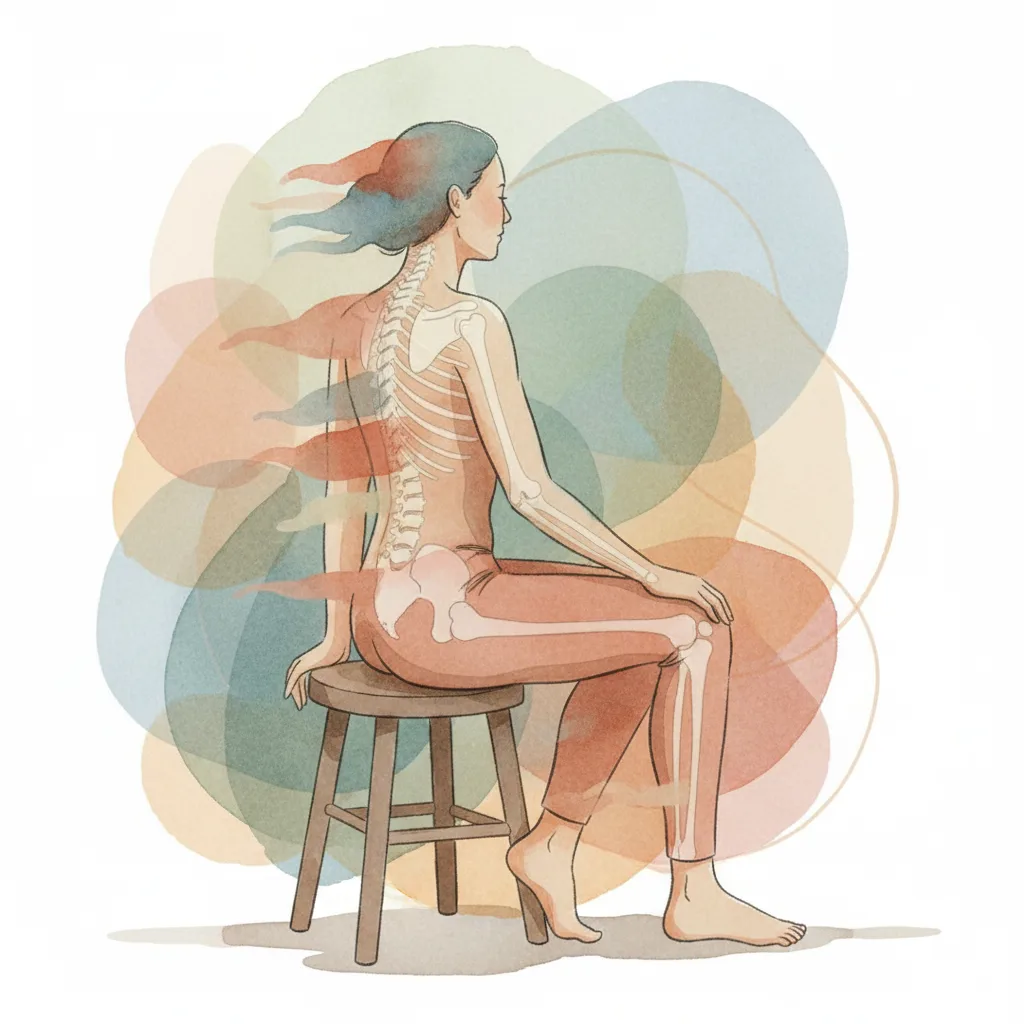

Beyond the Slouch: Real Posture for Real Life & Less Pain
Stop chasing rigid 'perfect' posture. Learn the practical, evidence-based habits that build resilient posture, reduce daily aches, and improve how you move through life. No nonsense, just what works.
When you hear 'posture correction,' do you picture yourself standing rigidly at attention, shoulders back, chest out? Most people do. But this outdated, often uncomfortable ideal is not only unsustainable; it's also not how your body is truly meant to function. Your body is designed for dynamic movement, not static perfection.
True, functional posture isn't about holding a single 'correct' position. It's about your body's efficiency in adapting to various demands, minimizing strain, and moving with ease. This deck will give you practical, evidence-based tools to build resilience and reduce daily aches, getting you beyond the myth of the 'perfect' posture.
One of the biggest myths surrounding posture is that there's a single, universally 'good' position we must all strive for. This couldn't be further from the truth. We are not statues; our spines have natural curves that allow for shock absorption and flexibility. Forcing yourself into an unnatural, rigid stance creates tension, fatigue, and can even contribute to pain rather than alleviate it.
Your body is incredibly adaptable. What matters most is your ability to maintain awareness and frequently change positions, rather than striving for an impossible, fixed ideal.
Instead of seeking rigidity, think 'dynamic posture.' This means your body is organized in a way that allows for efficient movement and balance, whether you're sitting, standing, lifting, or walking. It's about finding a neutral alignment that supports your joints and muscles without excessive effort.
Dynamic posture empowers you to move freely, adapt to different tasks, and reduces the cumulative stress that often leads to pain. It's less about 'holding' a posture and more about cultivating a body that naturally settles into efficient alignment.
Your 'core' is far more than just your abdominal muscles. Think of it as a cylindrical system of muscles and tissues – your diaphragm (roof), pelvic floor (floor), and the deep abdominal and back muscles (walls). When these muscles work together efficiently, they create internal pressure that stabilizes your spine and pelvis, acting as the foundation for all movement.
Neglecting this fundamental system means your limbs and other muscles have to compensate, leading to inefficient movement patterns and increased risk of injury or pain. A strong, functional core is central to good body mechanics.
While we often focus on the spine, tight hip flexors (muscles at the front of your hips) are a major culprit in lower back pain and poor standing posture. Prolonged sitting shortens these muscles, pulling your pelvis forward and increasing the curve in your lower back. This can lead to a host of issues, including a 'duck butt' appearance and difficulty extending your hips.
Addressing hip mobility through targeted stretches and movement is crucial for allowing your pelvis to return to a neutral position, directly improving both your static and dynamic posture.
Let's be clear: sitting isn't inherently bad. Your body is designed to sit. The problem arises from prolonged static sitting – staying in one position for hours on end. This reduces blood flow, stiffens joints, and dulls your proprioception (body awareness), contributing to muscle imbalances and pain.
The solution isn't to avoid sitting entirely, but to approach it with intention. Integrate movement, optimize your setup, and understand that variety is your spine's best friend. Think of sitting as a position to actively manage, not passively endure.
One of the simplest yet most effective posture hacks for desk workers is the micro-break. Set a timer for every 20-30 minutes. When it rings, take 30-60 seconds to do something simple: stand up, stretch your arms overhead, twist gently, or walk to the water cooler. These small movements break up static postures, re-engage circulation, and reset your body's awareness.
Don't wait for pain to be your alarm. Proactive movement snacks are a powerful tool against the negative effects of prolonged stillness.
If you're at a desk, try this simple reset: Shrug your shoulders all the way up to your ears, hold for a count of 3, then let them drop completely. Feel the tension release. Repeat 5-10 times. Then, roll your shoulders backward slowly in a circular motion 5 times, followed by 5 forward rolls.
This helps to counteract the common slouch and forward-rounded shoulders associated with computer use, improving blood flow and reducing tension in the neck and upper back.
Your thoracic spine (mid-back) often stiffens from hunching over devices. To counteract this, sit tall in your chair, scoot to the edge. Place your hands behind your head, elbows wide. Inhale, then as you exhale, gently arch your upper back over the back of your chair (or just extend gently backwards if no chair back) looking slightly upwards. Inhale to return. Repeat 8-10 times.
This gentle extension improves mobility where you need it most, alleviating pressure on your neck and lower back.
Tight hip flexors are a major contributor to lower back pain. To stretch them at your desk, stand up and take a big step forward with one leg, keeping your back leg straight. Gently tuck your pelvis under as if you're trying to flatten your lower back, and feel the stretch in the front of your back hip. Hold for 20-30 seconds per side.
This simple stretch can be done discreetly and effectively, helping to restore pelvic alignment and take pressure off your lumbar spine.
Your feet are the foundation of your entire body. Flat feet, high arches, or poorly supported footwear can create a cascade of issues up your kinetic chain – affecting your ankles, knees, hips, and ultimately, your spine. Think of it like a building with a cracked foundation; everything above it will eventually be compromised.
Pay attention to your footwear. Choose shoes with adequate support and cushioning, and consider exercises to strengthen your foot muscles. A stable foundation is paramount for resilient posture.
Believe it or not, how you breathe directly impacts your core stability and posture. Shallow, chest-dominant breathing bypasses your diaphragm, which is a key player in your core cylinder. When your diaphragm isn't engaged, your deep core muscles often don't activate properly, leaving your spine vulnerable.
Practice diaphragmatic breathing: lie down, place one hand on your chest and one on your belly. As you inhale, focus on expanding your belly (hand on belly rises) while your chest remains relatively still. Exhale slowly. This strengthens your core from the inside out.
The 'tech neck' or 'forward head posture' is incredibly common and damaging. Constantly looking down at phones or computers strains the muscles and ligaments in your neck, often leading to headaches, upper back pain, and shoulder issues. For every inch your head moves forward, the weight your neck has to support effectively doubles.
Practice the 'chin tuck': sit or stand tall, gently pull your chin straight back, as if making a double chin. Feel the back of your neck lengthen. Hold briefly and release. Integrate this into your screen time habits.
When someone tells you to 'stand up straight,' your instinct might be to yank your shoulders back, creating tension and an unnatural stiffness. This often leads to a 'puffed out' chest that pushes your ribcage forward and strains your lower back. True postural awareness is more subtle and organic.
Instead of pulling back, think about gently broadening your collarbones and letting your shoulders relax down your back. Imagine a string pulling the crown of your head gently towards the ceiling, elongating your spine. This creates natural openness and alignment without force.
Posture correctors and braces are a tempting quick fix, but they rarely address the root cause of poor posture. While they can provide temporary feedback, relying on external support often weakens the very muscles you need to strengthen for sustainable posture. Your muscles learn to become passive, rather than active stabilizers.
The goal is to teach your body to hold itself in efficient alignment, not to outsource the job to a piece of plastic or fabric. Focus on active engagement, not passive dependency.
Expensive ergonomic chairs and fancy gadgets aren't the magic bullet for better posture. The most important 'ergonomic' adjustment you can make is to understand how your body interacts with your environment. Set your monitor at eye level, so your neck isn't craning up or down. Ensure your feet are flat on the floor or a footrest, and your knees are at roughly 90 degrees.
Position your keyboard and mouse close to your body to avoid reaching, which strains shoulders and wrists. Regular assessment and adjustment of your personal workspace are far more effective than any single purchase.
How you carry your bags can significantly impact your posture. Regularly lugging heavy backpacks on one shoulder, or carrying an oversized purse, creates asymmetrical stress on your spine and shoulders, leading to imbalances and pain.
Opt for backpacks with two padded straps and use both. When possible, keep your loads lighter. If you must carry a shoulder bag, alternate shoulders frequently to distribute the load, or choose a cross-body style that sits closer to your center of gravity.
Yes, your sleeping position matters! While there's no single 'best' position for everyone, aim to maintain the natural curves of your spine as much as possible. Side sleepers should place a pillow between their knees to keep hips and spine aligned. Back sleepers can use a pillow under their knees to reduce lower back strain.
Avoid sleeping on your stomach, as this often forces your neck into an extreme rotation for prolonged periods, leading to neck pain and headaches. Invest in a good, supportive pillow that cradles your neck without propping your head too high or low.
Hydration might not seem directly related to posture, but it plays a crucial role in the health of your intervertebral discs – the shock absorbers between your spinal bones. These discs are largely made of water, and proper hydration helps them remain plump and functional. Dehydrated discs are less able to absorb shock and can lead to stiffness and pain.
Make sure you're consistently drinking enough water throughout the day. It's a simple, foundational habit that supports overall spinal health and, by extension, better posture.
While this deck provides practical tools for self-management, it's vital to recognize when professional help is needed. If you experience persistent pain that doesn't improve with lifestyle changes, numbness or tingling in your limbs, sudden changes in strength, or pain that interferes with sleep, it's time to see a healthcare professional.
As a chiropractor and movement specialist, my role is to diagnose underlying issues and guide you through a tailored treatment and rehabilitation plan. Don't ignore significant pain; it's your body's way of telling you something needs attention.
Movement is medicine. Our bodies are designed to move, and regular, varied movement is the best defense against stiffness, pain, and poor posture. Don't be afraid to move, even if you have experienced pain in the past. Smart, controlled movement can be therapeutic and empowering.
Embrace activities you enjoy – walking, yoga, dancing, cycling – and try to integrate movement throughout your day, not just during dedicated exercise sessions. Your body's resilience is built through consistent, mindful motion.
Ultimately, developing better posture isn't about achieving an aesthetic ideal or punishing yourself with rigid rules. It's about cultivating a deeper awareness of your body, understanding its mechanics, and making small, sustainable choices that support its health and function.
Focus on ease, mobility, and adaptability. By integrating these practical, evidence-based principles into your daily life, you can reduce pain, enhance your movement, and build a more resilient, capable body for years to come. Your posture is a lifestyle, not just a pose.