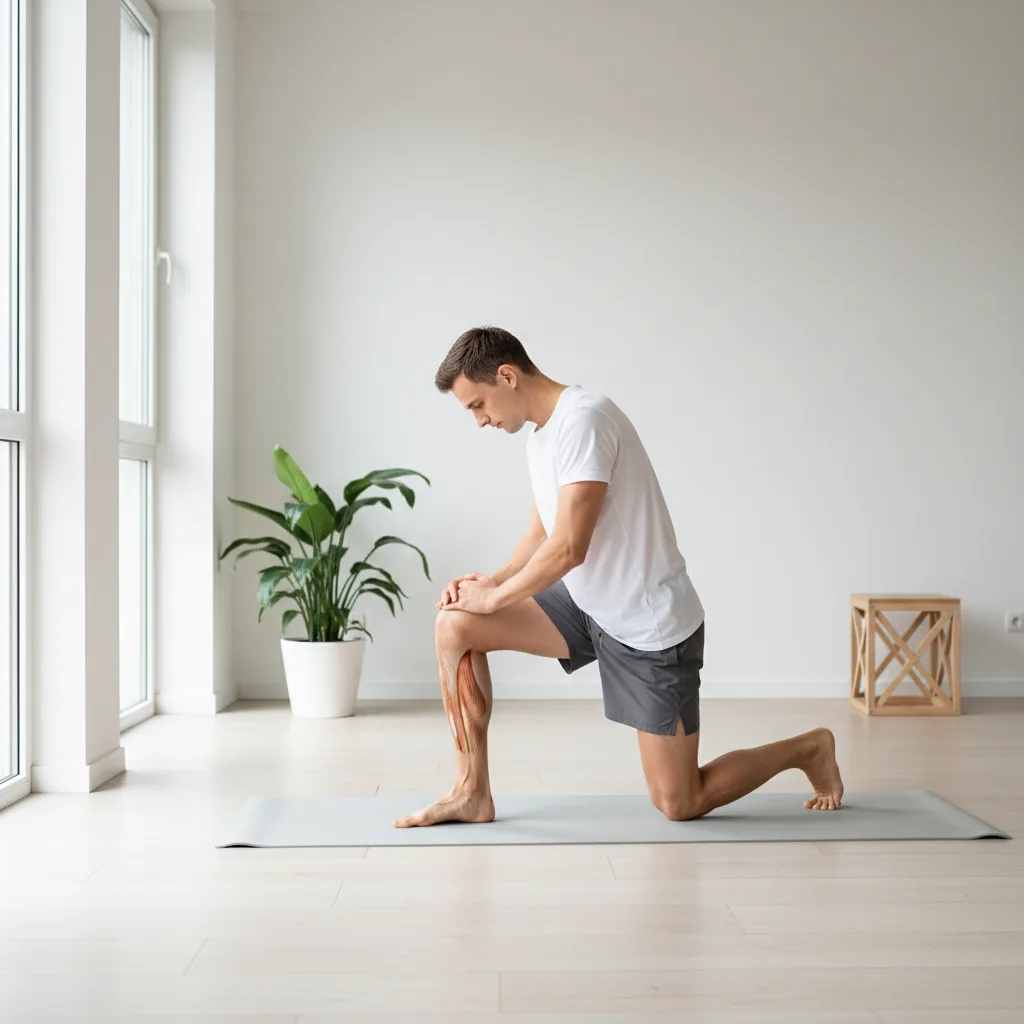

Ankle Mobility: The Foundation You Are Ignoring
Your ankles affect your knees, hips, and back. Here is how to test and fix them in 5 minutes.
Dr. Miles Reynolds, DPT
Your ankles are the foundation of your entire movement chain. When they are stiff, everything above them compensates. Knee pain, hip tightness, and even lower back issues often trace back to limited ankle mobility.
Why Ankle Mobility Matters
Every time you walk, squat, climb stairs, or stand up from a chair, your ankles need to dorsiflex (bend upward). If they cannot move through their full range, your body finds workarounds. Those workarounds become pain.
The Wall Test (Try This Now)
Stand facing a wall. Place one foot about 5 inches from the baseboard. Try to touch your knee to the wall without lifting your heel.
- Pass: Knee touches wall easily, heel stays down
- Borderline: Knee barely touches, heel wants to lift
- Fail: Knee cannot reach the wall
Test both sides. Asymmetry matters just as much as overall range.
Why Your Ankles Got Stiff
- Years of wearing shoes with elevated heels (yes, even "flat" shoes have a heel drop)
- Sitting for long periods with ankles in a neutral position
- Old sprains that healed with scar tissue
- Never training ankle range of motion directly
The 5-Minute Ankle Mobility Routine
Do this daily. Morning or evening. Barefoot is best.
Move 1: Banded Ankle Distraction (2 min)
Loop a resistance band around a sturdy anchor at floor height. Step into the band so it sits just below your ankle bone on the front of your foot. Step forward to create tension. Lunge forward slowly, driving your knee over your toes. Hold 5 seconds, return. Repeat 10 times each side.
The band pulls the talus bone backward, creating space in the joint. This is the single most effective ankle mobility drill.
Move 2: Elevated Calf Stretch (1 min)
Place the ball of your foot on a step or thick book. Let your heel drop below the edge. Hold 30 seconds. Then slightly bend your knee and hold another 30 seconds (this targets the soleus, the deeper calf muscle most people miss).
Move 3: Ankle CARs (1 min)
CARs = Controlled Articular Rotations. Lift one foot and slowly draw the biggest circle you can with your toes. Go clockwise 10 times, then counterclockwise 10 times. Each circle should take about 3 seconds. The goal is smooth, full-range movement.
Move 4: Deep Squat Hold (1 min)
Drop into a deep squat with your heels on the ground. If your heels lift, hold onto a doorframe or place a rolled towel under your heels. Stay here and breathe. This position loads the ankles in full dorsiflexion while also opening the hips.
Common Mistakes
- Bouncing instead of holding. Mobility is about sustained tension, not ballistic stretching.
- Only stretching the gastrocnemius (straight knee). You must also stretch with a bent knee for the soleus.
- Ignoring one side. Ankle asymmetry is a major injury predictor.
The Downstream Effect
In clinical practice, I see patients with chronic knee pain who have never been assessed for ankle mobility. When we restore dorsiflexion, the knee pain often resolves without any knee-specific treatment. The body is a chain. Fix the foundation and the structure follows.
Your Action Plan
- Do the wall test today. Note your distance.
- Do this routine daily for 2 weeks.
- Retest. Most people gain 1-2 inches of knee-to-wall distance.
Screenshot this deck and set a daily reminder. Five minutes a day can change how you move for the rest of your life.